Islam: Between East and West – Video Highlights

Learn from the people who built the systems.
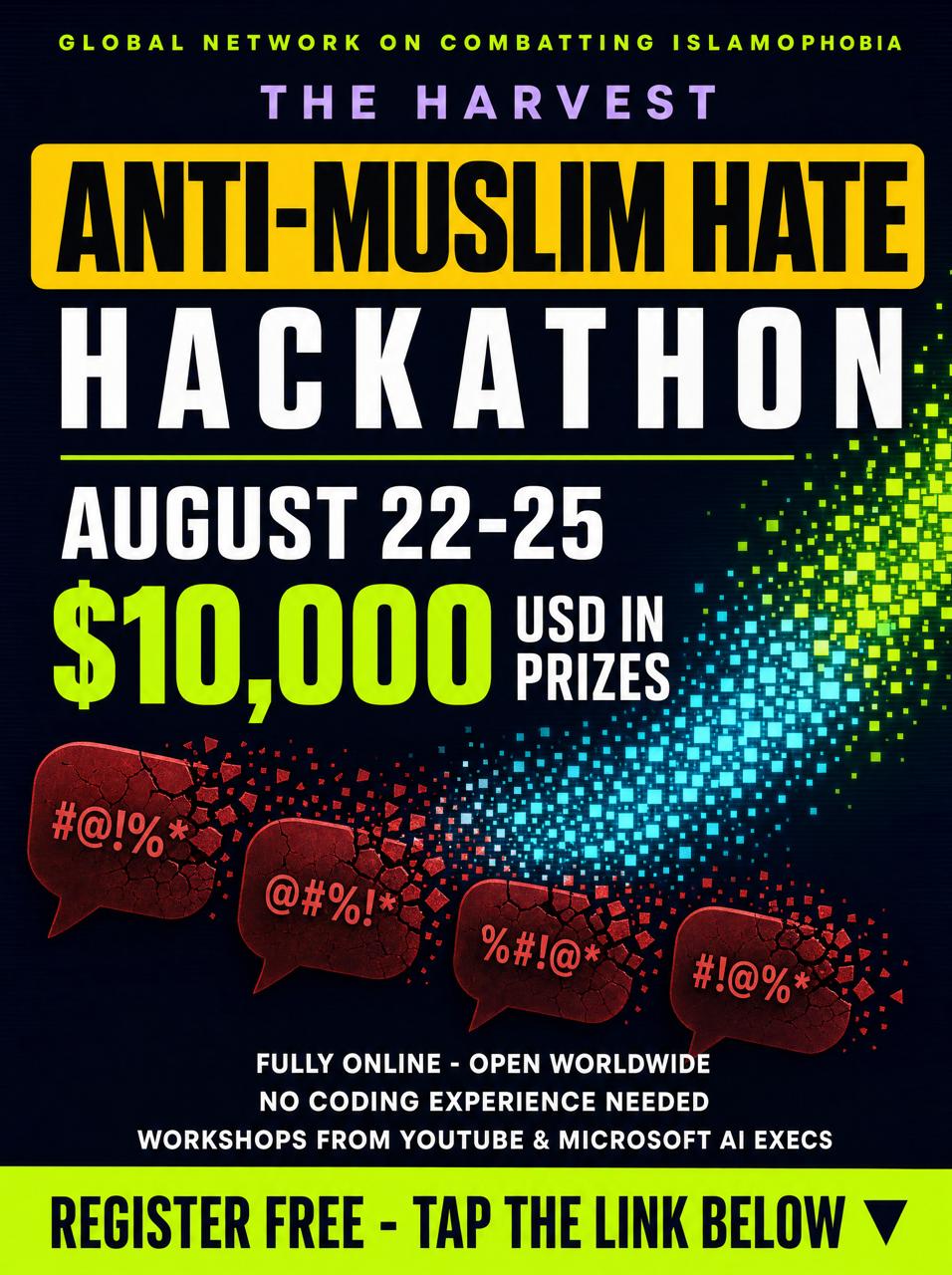
Current and former executives from YouTube and Microsoft AI are running live workshops at a free hackathon against online anti-Muslim hate — and you can be in the room.
The Harvest Anti-Muslim Hate Hackathon
Aug 22–25 · fully online · open worldwide · $10,000 USD in prizes
Register:
https://us05web.zoom.us/meeting/register/I91nZ_1BQ5y2V69gFV4-rg
Why this exists
You’ve seen it. The meme that isn’t really a joke. The comment section that turns the second a Muslim name shows up. The dog-whistle you clocked but couldn’t explain to anyone else.
Almost none of it ever gets flagged, countered or recorded — not because people don’t care, but because nobody’s organised to do it. The hate follows a playbook and crosses borders in hours. The response is one deleted comment and a screenshot that goes nowhere.
Four days to change that.
What happens
Sat 22 Aug, 9am–12pm PT — three hours of live workshops from current and former YouTube and Microsoft AI executives, plus online-safety experts. These are the people who built and ran the enforcement systems this hate travels through, telling you how it actually works from the inside. That access alone is worth the weekend. All sessions recorded.
Sat to Mon — you build. An app, a browser extension, a detection model, a dataset, a reporting tool, a campaign, a curriculum. Projects due Monday 24 Aug at 12pm PT.
Tue 25 Aug — the top ten pitch live to judges from the platforms their work is aimed at. $10,000 USD to the top three: $5,000 / $3,000 / $2,000.
You don’t need to code. With today’s AI tools, if you can describe the idea clearly you can build a working prototype. Plenty of the strongest entries won’t be software at all — research, curriculum, campaigns all
Tuesday 14 July, 2026
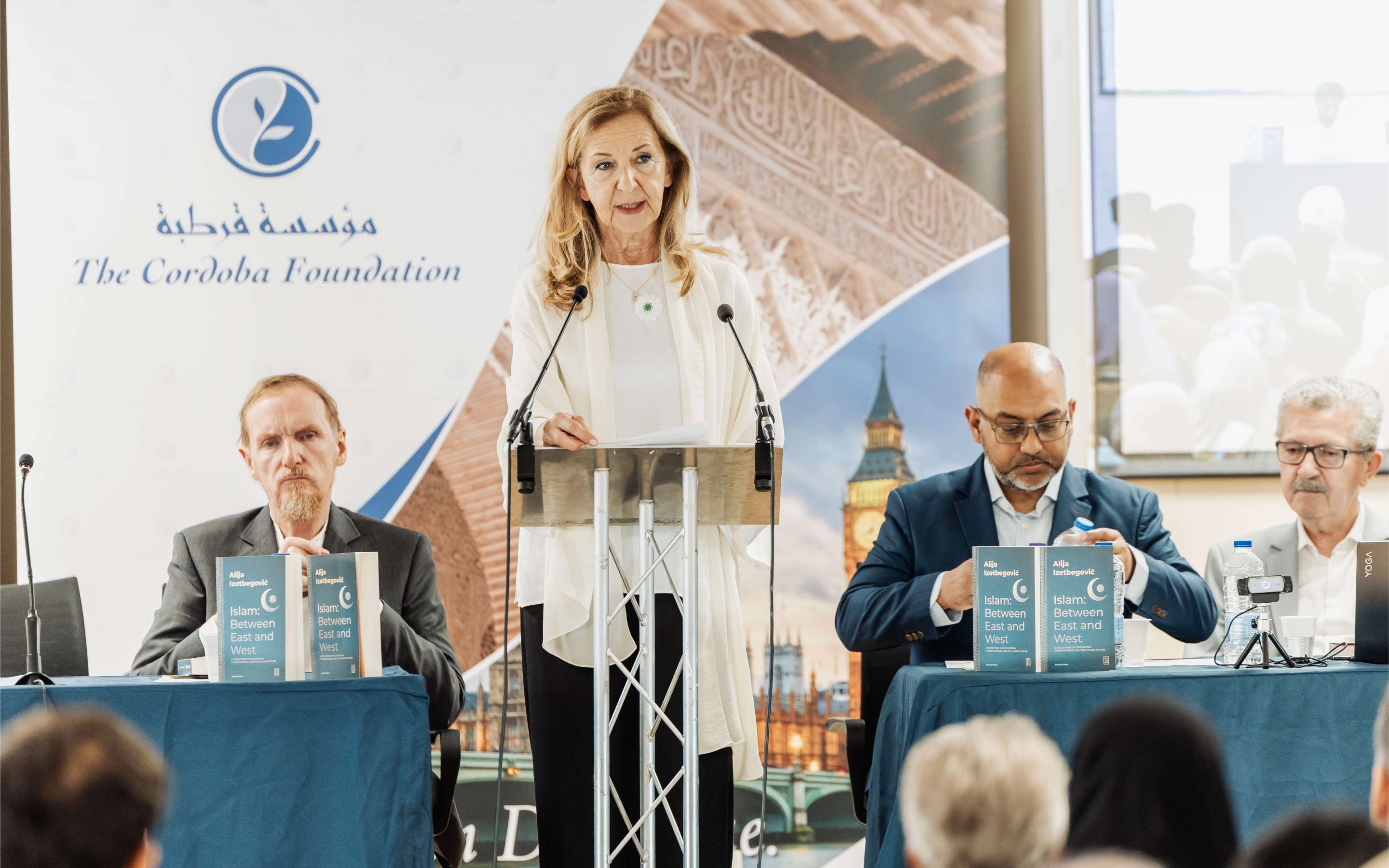
Hundreds mark 31 years since Srebrenica at London launch of Alija Izetbegović’s Islam: Between East and West
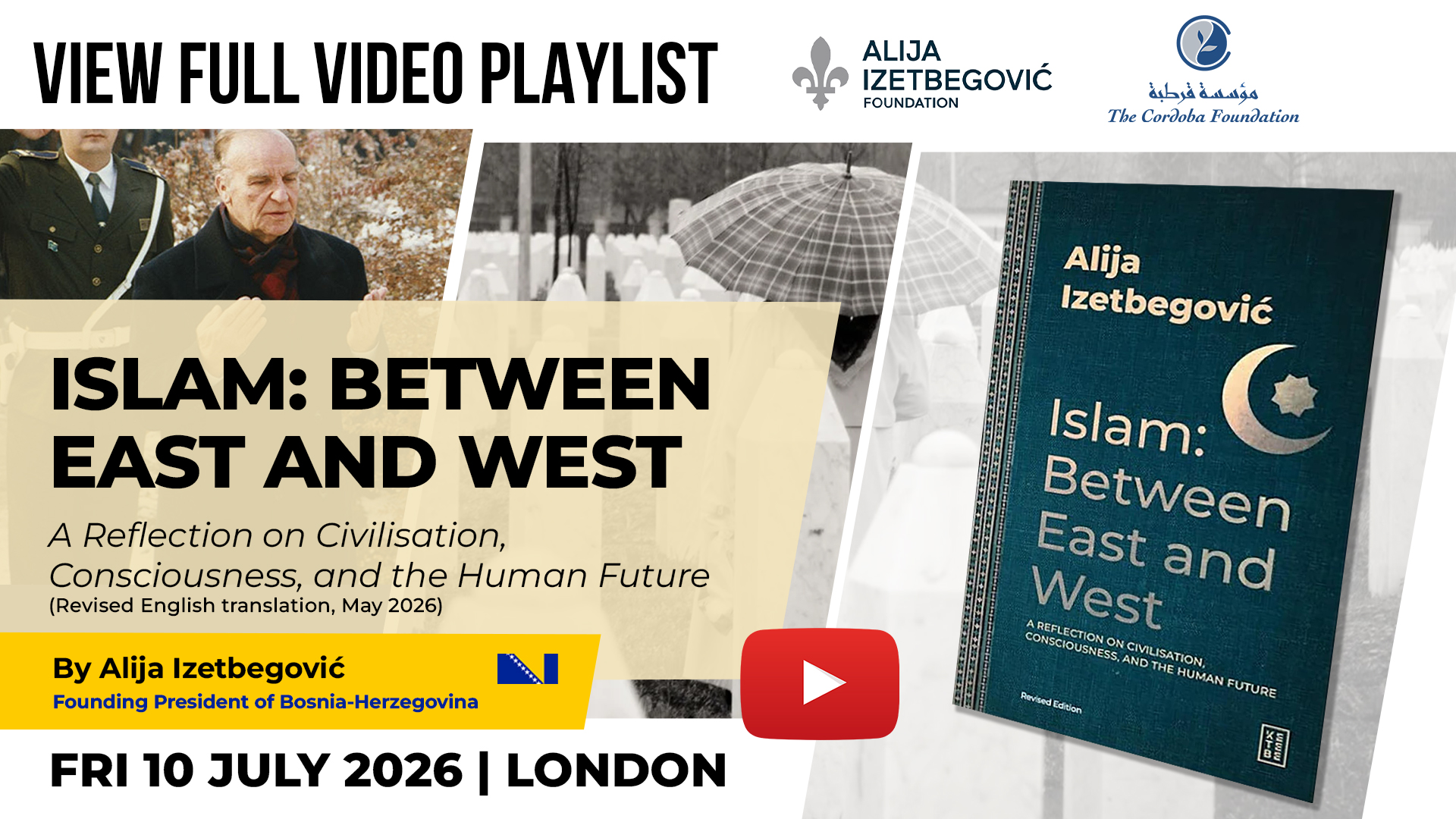
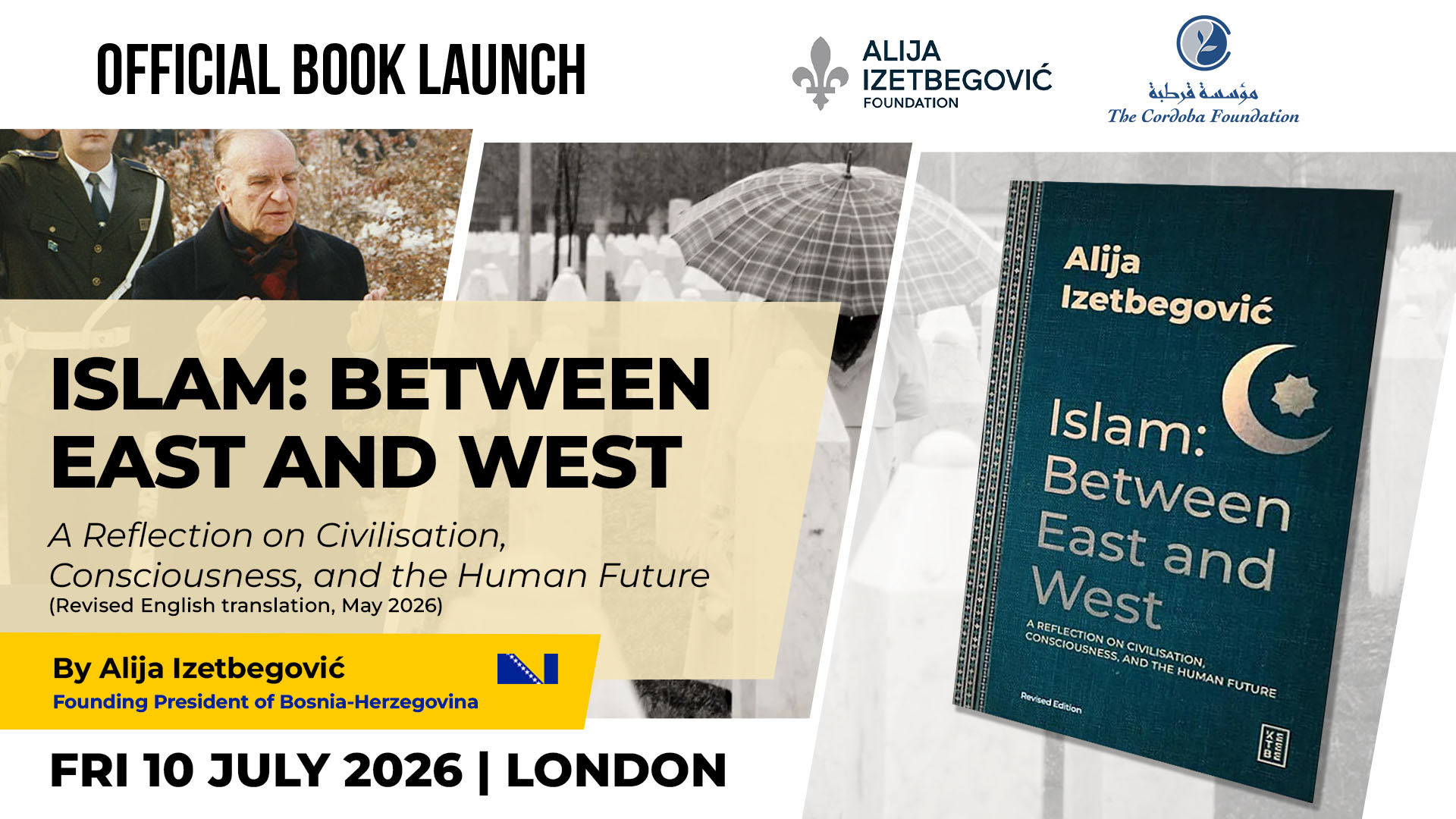
The newly revised English translation of Islam: Between East and West — the philosophical work of Alija Izetbegović, the philosopher, statesman, and Founding President of Bosnia-Herzegovina — was launched on Friday, 10 July 2026, at the London Muslim Centre, during an evening that also commemorated the 31st anniversary of the Srebrenica Genocide.
Hosted by The Cordoba Foundation and the Alija Izetbegović Foundation, alongside several supporting organisations (including the book’s publisher, Ketebe), the launch drew over 400 guests from across the country. Attendees included many youth as well as a Turkish delegation. Streamed live on The Cordoba Foundation’s YouTube and Facebook channels, the event proved highly successful, with nearly 300 copies of the book sold at the beginning of the evening.
Moderated by Dr Abdullah Faliq, Managing Director at The Cordoba Foundation —who brings 25 years of advocacy for the victims of Srebrenica — the event commenced as he welcomed the panel of speakers and guests. He described Izetbegović’s magnum opus as “a major contribution to understanding the human condition, consciousness, and the metaphysical foundations of ethics.”
Elaborating further, he said: “Many of us grew up reading this text, which positions Islam not just as a religion, but as an integrative worldview capable of harmonising humanity’s spiritual and material needs. The book has striking relevance for us today as we try to navigate conflicts, tensions, and the rise of right-wing populism across the globe.”
Imam Sedin Sahman, Chief Imam of the Islamic Bosnian community in Britain and a survivor of the Bosnian War, recited verses from the Qur’an. This was followed by opening remarks from H.E. Osman Topčagić, Bosnian Ambassador to the UK, who recalled working alongside President Izetbegović throughout the war years and the Dayton peace negotiations. “In all those situations, I had in front of me a statesman, but also a man who cared deeply for human beings: care for the people, care for others, and not just for one ethnic or religious group, trying to find a formula to enable life together,” he said. “Bosnia and Herzegovina remembers the work and life of Mr Izetbegović. What we have today is very much because of his actions and his deeds.”
The highlight of the evening was a keynote address by Sabina Berberović, daughter of President Izetbegović and a founding member of the Alija Izetbegović Foundation. Speaking on the eve of the Srebrenica Genocide anniversary, she stated: “Thirty-one years on, we remember the victims of the genocide, and we stand with their families: thousands of women and children who lost their fathers, their brothers, their husbands. It takes immense courage to continue living after such a terrible experience,” she said. “They are enduring the unendurable and accepting the unacceptable. The women of Srebrenica rose from being victims to become our heroes, and they raised their children with pride and dignity.”
She shared the story behind her father’s book, which Izetbegović began writing as a high school student during the Second World War. The manuscript was hidden by his sister under a flower chest in the family kitchen when police searched their home in 1946, and it was completed three decades later. By the time State Security agents targeted him again in the 1980s, the finished manuscript was safely in the possession of a friend in Canada. “As they were leaving, I asked my father what we were to do, and he just replied: ‘Have the book published,’” she recalled.
The book was published in 1984 while Izetbegović served a prison sentence. Sabina’s brother and husband later drove the first copies from Belgrade to Sarajevo in the boot of a car, taking rural backroads to avoid being stopped and searched. “I hope that the book Islam: Between East and West will only bring good wherever and whenever it is read,” she said.
Ömer Faruk Yeni, an arts and cultural heritage consultant and the London and Istanbul-based director of Ketebe publishing, provided an overview of the book. “This is not a book about East or West, nor is it a defence of one civilisation against another. It is a profound reflection on what it means to be human. More than forty years have passed since the book first appeared, yet its questions have only become more relevant. Increasingly, Izetbegović is recognised not only as the founding President of Bosnia and Herzegovina, but as one of the most original Muslim thinkers of the twentieth century.”
In a recorded address, Dr Admir Mulaosmanović, CEO of the Aurora Foundation in Sarajevo and a wounded veteran of the Bosnian War, framed the book within the context of the present day. “The question Izetbegović posed rings even more powerfully today than when it was first written down,” he said. “This is not a theological text. It is an attempt to translate Islam into a language spoken and understood by today’s generation, and a call for both individual intellectual sharpening and collective social action.”
(Note: Mulaosmanović’s full written speech is available here)
Shaykh Prof Abdal Hakim Murad, Dean of the Cambridge Muslim College, recounted travelling to Sarajevo in the 1980s to write a report for Amnesty International on the trial of Izetbegović and his co-defendants. Europe’s response to Bosnia, he argued, exposed a lasting blind spot. “The Bosnian struggle was not just a military struggle. It was against a European determination to defend a cultural truth rather than a factual truth,” he said. “We see this today in Gaza: so many hand-wringing politicians who have read the reports and know what is going on, but it is not their cultural truth, and so they are paralysed.”
Murad warned that “Muslim communities across Europe are witnessing the storm clouds gathering on the horizon”, adding that Bosnia holds a vital lesson: “Bosnians can teach us what that is like, and how to avert it. We need to challenge cultural truths with factual truths. We need to go to Bosnia, we need to read this great literature, and we need to make that history part of our history.”
Shaykh Dr Yasir Qadhi, a prominent American theologian who sent a video message while travelling, described first reading the book as a teenager in 1990. “This book is one of the few genuinely unique philosophical contributions of the Muslim Ummah in this century, in a similar vein to Iqbal’s Reconstruction of Religious Thought. What makes it especially important is not just the message, but that it comes from somebody who paid a personal price for what he wrote. Izetbegović was not a mere armchair critic. He lived the life of a bona fide leader who had to navigate his nation through a war,” he said.
“This book should be mandatory reading for all who want to traverse the path of intellectual scholarship, especially in the Western world, because it answers the question: what vision of the human person makes Islam intelligible?”
Sarah Joseph OBE, a writer, broadcaster, and founding editor of Emel magazine, focused on the book’s chapter on progress. “Izetbegović asks whether life will be five times fuller, happier, or more humane, and his answer is decidedly negative. Another forty years on, have we quintupled in our happiness? Again, the answer is decidedly no,” she said.
Addressing the rise of the far-right in Europe, she rejected fear: “This book is calling us towards civilisation. It is calling us to say: we are not victims. We are people inspired by ideas, and we have a vision for the future. The Prophet Muhammad did not come for the Muslims; he came as a mercy to mankind. That is a civilisational message, and that is what this book tells us.”
Dr Mohammed Wajid Akhter, Secretary-General of the Muslim Council of Britain, remembered discovering the book as a child in Saudi Arabia during the genocide, noting it was one of only two English titles in his mosque. “The imam came to me one day and said: ‘This is why the Bosnians will win. You can kill a people, but you cannot kill an idea,’” he shared. Izetbegović, Akhter argued, possessed the rare vision, courage, and pragmatism that eventually guided his nation to survival and left a timeless intellectual blueprint for future generations.
Izetbegović, Akhter argued, possessed the vision, courage, and pragmatism every leader needs, alongside something far rarer. “He did something very few Muslim leaders do: he voluntarily stepped down,” Akhter noted. “Throughout 1,400 years of Muslim history, leaders have traditionally left office only for the graveyard. Izetbegović chose to leave before then, showing the true measure of the man.”
Former BBC war reporter Martin Bell, who was wounded during the siege of Sarajevo, sent his apologies as ill health prevented his attendance.
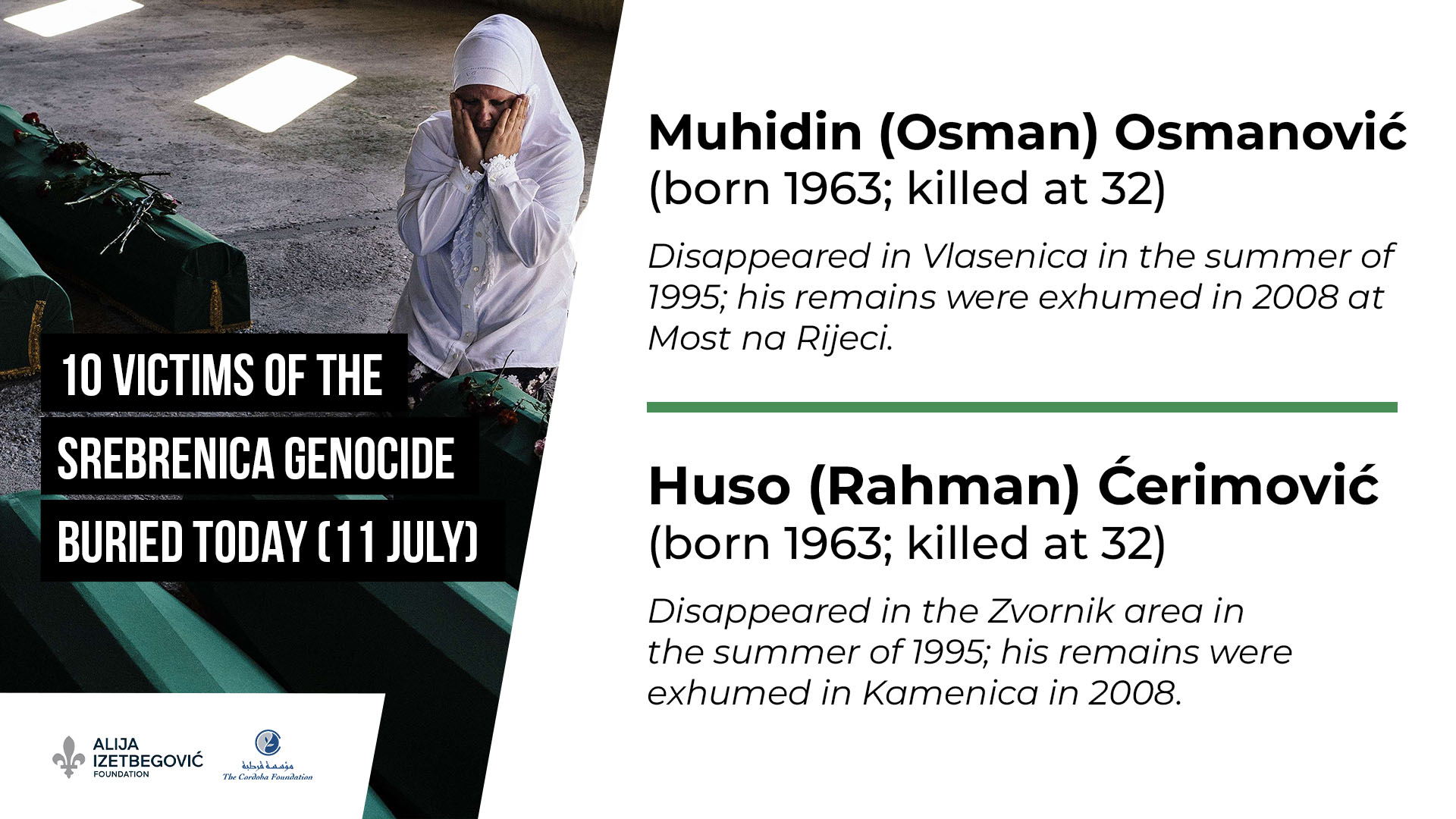
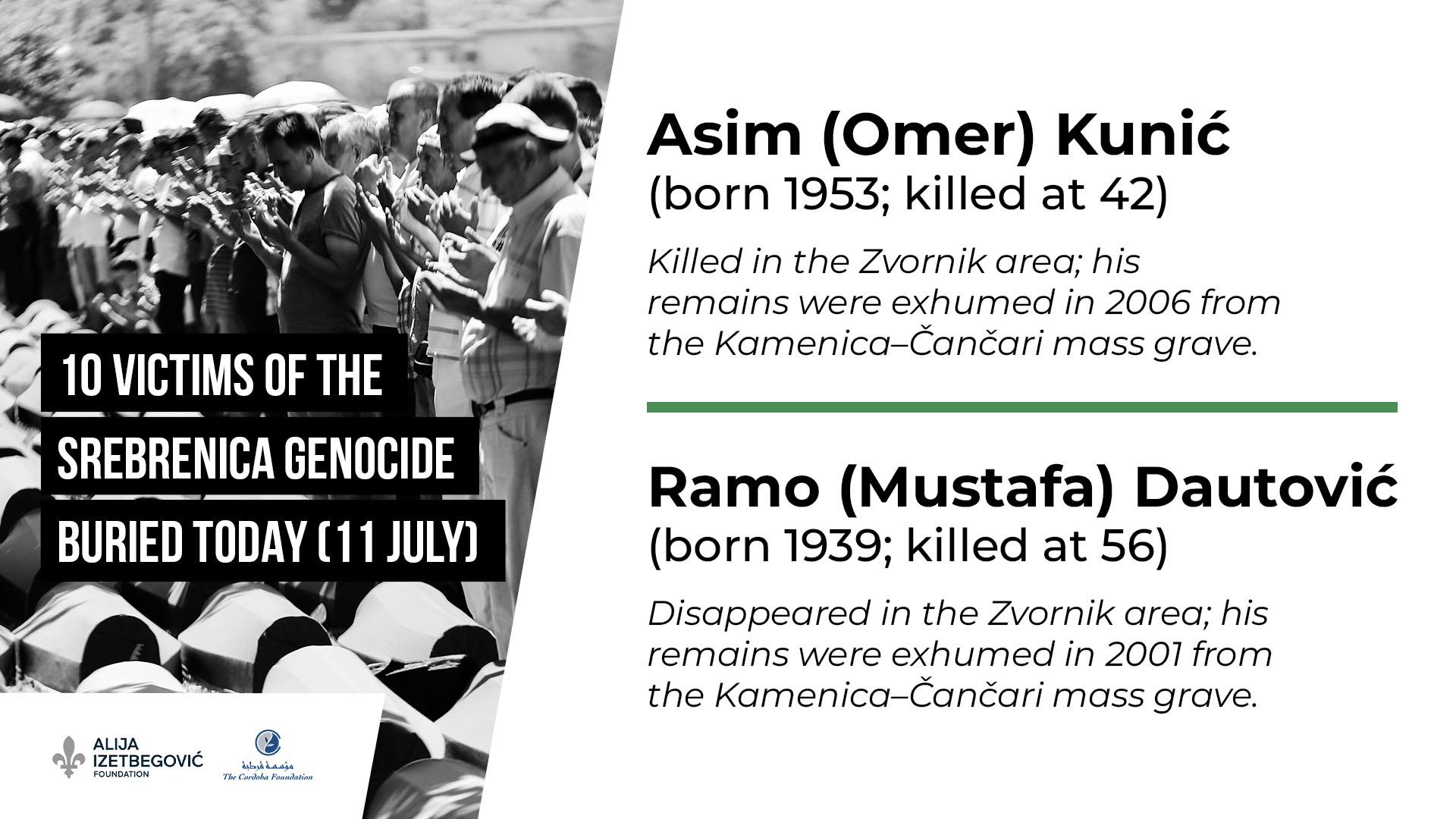
Dr Abdullah Faliq asked for prayers and reflection for ten genocide victims whose remains were identified this year, ahead of their burial at Srebrenica on 11 July. He also highlighted the Bosnian Grand Mufti’s Friday Sermon delivered earlier that day in Sarajevo, noting its timely messages of steadfastness and enduring faith.
Faliq urged the youth to study the history of Srebrenica, recommending a special publication, Srebrenica Genocide: 30 Years Later: Understanding, Remembering, Acting by Dr Emir Hadžikadunić. The publication features insights from Bosnia’s Grand Mufti, the Bosnian Ambassador, and ICMP Director Kathryne Bomberger.
Sarah Joseph urged the audience to visit the country: “Go, support the economy, support the people, and know that their stories will never die.”
Closing the evening, Faliq reflected on the ongoing pain of families still recovering the remains of loved ones 31 years later. “Let us not do this once a year only,” he pleaded. “We must keep the flame of Srebrenica alive and tell these stories all year round.”
[Ends]
Notes to editors:
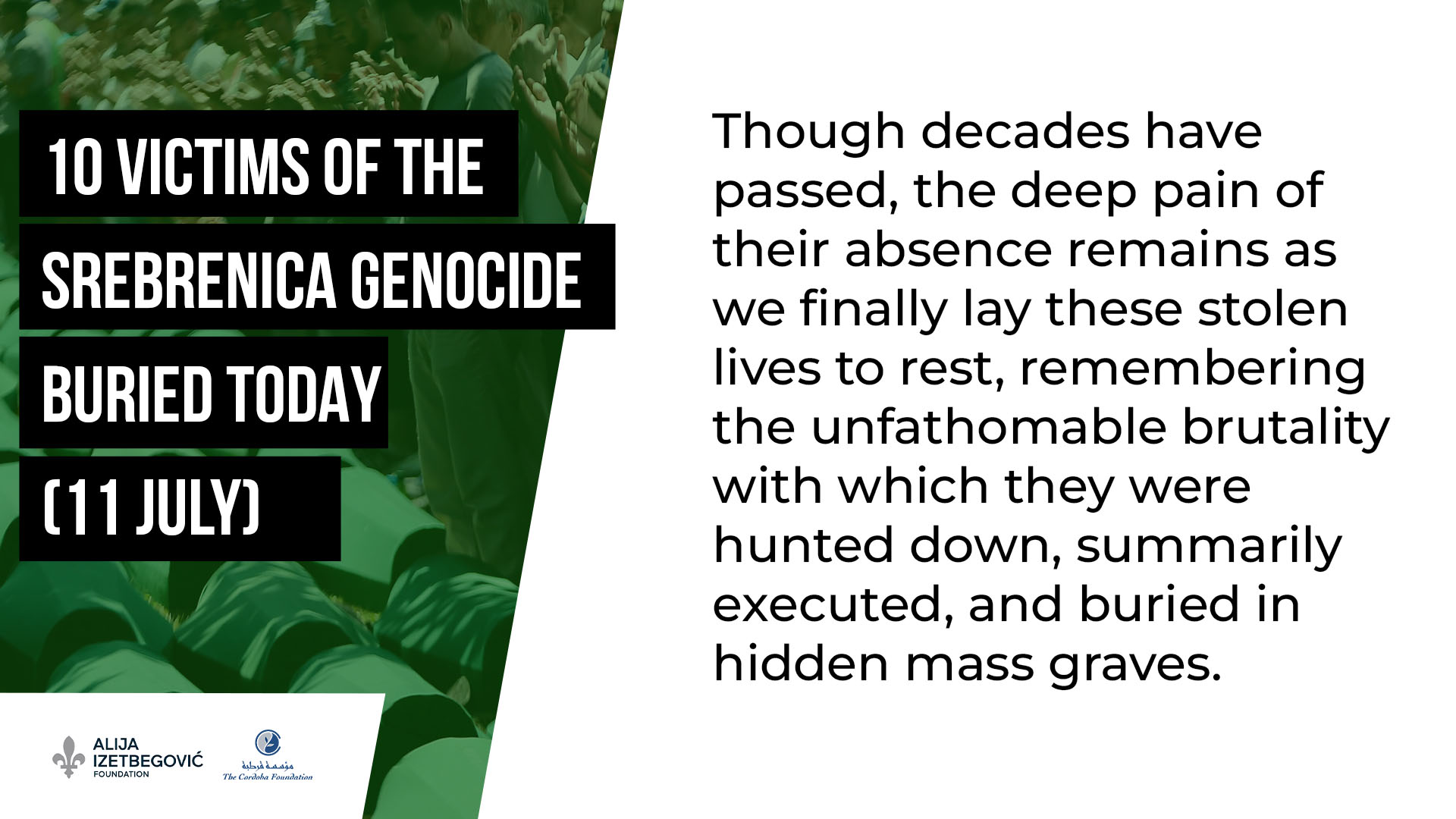
Though decades have passed, the deep pain of their absence remains as we finally lay these stolen lives to rest, remembering the unfathomable brutality with which they were hunted down, summarily executed, and buried in hidden mass graves.
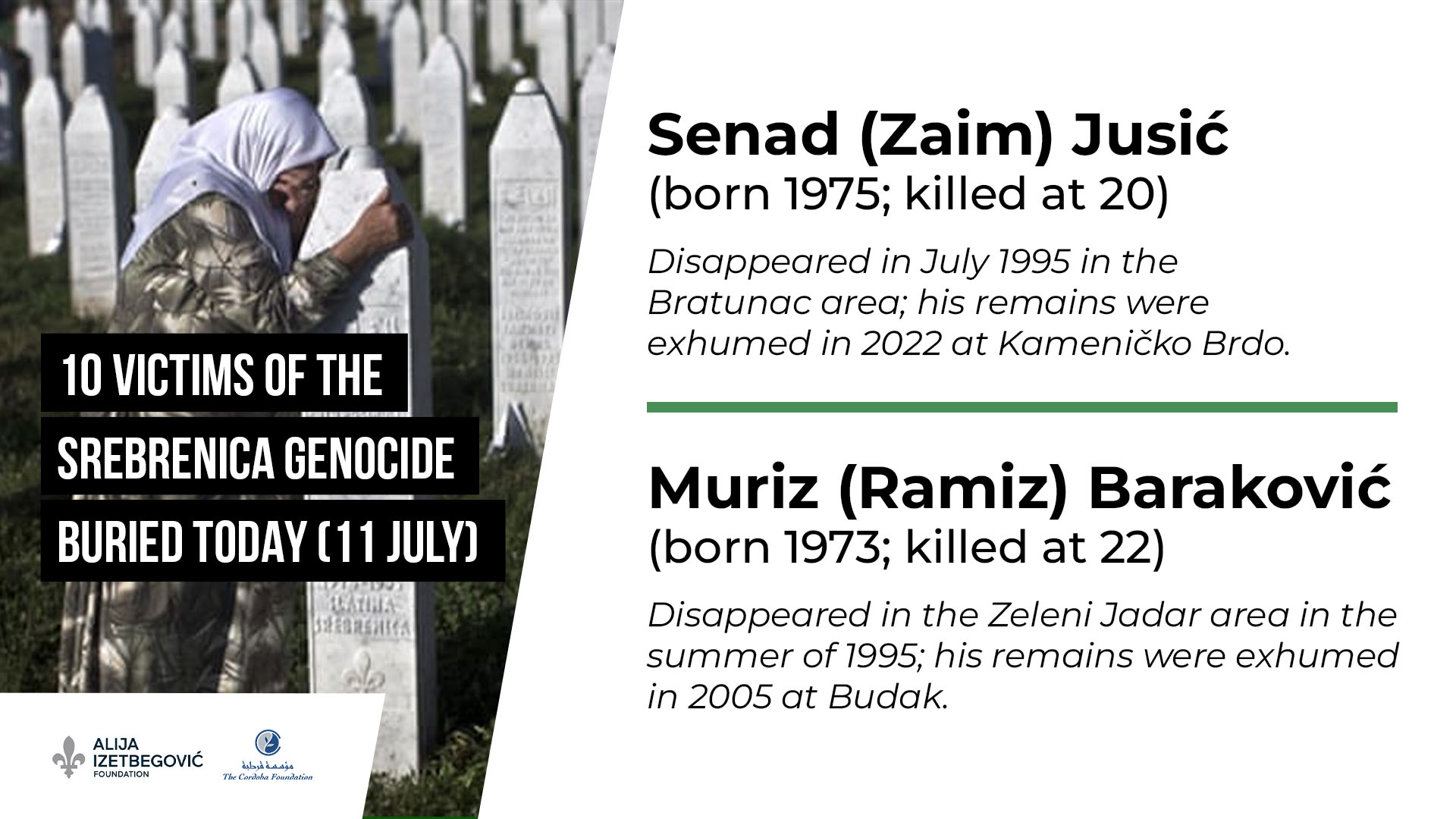
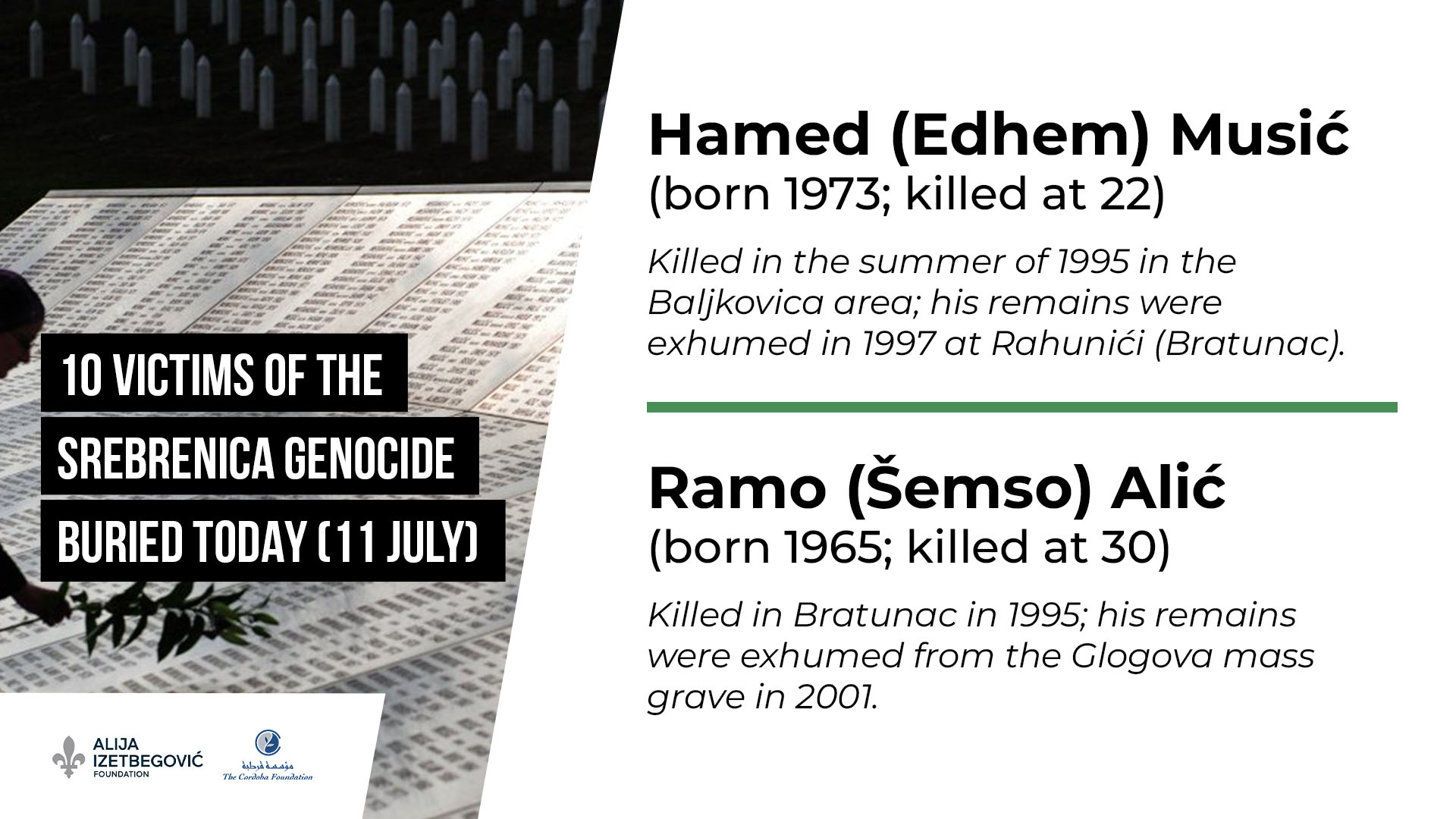
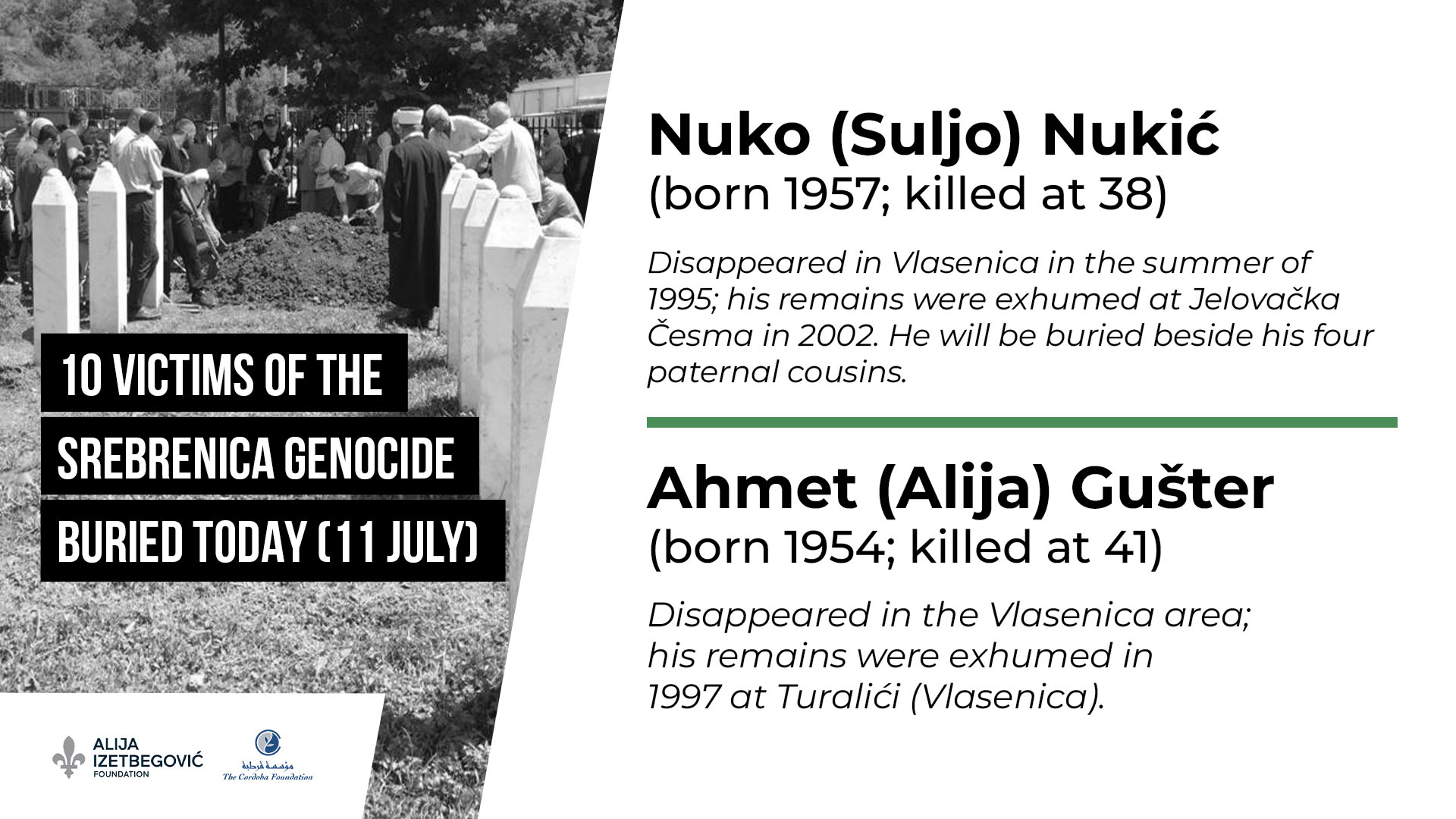

Official book launch, Islam: Between East and West by Alija Izetbegovic
The Cordoba Foundation & Alija Izetbegovic Foundation
10 July 2026, London Muslim Centre
“The contemporary world is marked by a sharp ideological conflict that has been going on for years and whose end is not in sight. We are all involved in this conflict in one way or another, either as its participants or as its victims. What is the place of Islam in this gigantic confrontation? Does it have any role in shaping today’s world? This book attempts to answer that question, at least partially.”
I begin this short address with a sentence from the introduction to the book, Islam: Between East and West, which, both then and now, poses one of the key questions for Muslim thinkers and all those who take Islam as a guide in life. The thought expressed — the question that Alija Izetbegović posed—rings even more powerfully today than when it was first written down. The bipolar order that shaped his approach has ceased to exist, but the multipolar one is slowly becoming a reality that must be reckoned with, which emphasizes the need to define the role of Islam in it.
Due to this multifaceted confrontation, relations have become more complex and subtle, and the world taking shape before our eyes is both troublesome and worrying. The role of Islam in a bipolarly divided world and the Cold War environment was great, but in the most significant aspect, it remained unrealised. Today, as in the near future, this role is becoming — and will become — even more pronounced, but the possibility that it will be neglected, as it was during the twentieth century, remains a realistic scenario.
However, a repetition of the twentieth-century lethargy of Islamic thought would be worse than humiliating. The Islamic idea has become crucial not only for defining one’s own position, but also for the survival of a world in which humanity does not become a mere statistical entry or “quantified energy that produces guaranteed profit.” Instead, it offers a vision of a being imbued with meaning in the fullness of his action and existence — “a being of call and response” whose essence is fulfilled in the drama of existence. Therefore, within the dehumanising rush of the Anthropocene era that humanity has built against itself, Islam provides both a teaching and an order capable of restoring the lost meaning of anthropos by re-establishing humanity as a unique presence within theocentric discourse. Yet, in this immense new confrontation, this role must first be accepted, and then actively performed.
In this work, Izetbegović reveals the return of reality’s missing inner dimension of reality — a dimension linked to the drama of existence and the testimony of humanity’s arrival from the Unknown — by contrasting Michelangelo with Darwin. In doing so, he sharply contrasts art with science. He argues that, at its most authentic, art is the history of human alienation. This is precisely why science and art are in complete, irrevocable conflict regarding the origin and nature of humanity. Izetbegović claims that a science of humanity is possible only if man is viewed as a part or product of the external world, whereas art is possible only if man is distinct from nature — a stranger within it.
For Izetbegović, however, being a stranger means being a true individual — that is, achieving and realising the full capacity of a person. He emphasises this sense of foreignness, viewing this inner dimension of reality as the conscious meaning of existence.
For Izetbegović, therefore, this meaning is thoroughly reflected in the ultimate humanisation of the individual. Through countless examples — often defying worldly logic — he shows how this state is achieved. “Fighting for other people, or for truth, justice, and goodness, is always a negation of the narrowness and finitude of life. The sacrifices of those who lose their lives, freedom, and peace because they remain faithful to moral laws represent the most profound revelation of the infinity of life and its higher, secondary meaning. These are sparks of light that, like a flash of lightning in a dark night, instantly illuminate distant horizons for us.” This is one of the core convictions he expresses in his elaboration on what it means to become fully human.
Reading Islam: Between East and West leads to the conclusion that Izetbegović’s thought is provocative, yet primarily avant-garde. Unburdened by the traditional framework defined by the Ottoman and post-Ottoman systems of Islamic scholarship, his thought transcends these limits, ascending to higher levels of theoretical reflection on Islam and its position in a divided world. He engages in dialogue with intellectual giants, seamlessly incorporating their thoughts and ideas into an explanatory framework that establishes his own argument.
Izetbegović approached society, politics, culture, and all other topics from the position of an advocate building a system based on the Islamic worldview. This is why Islam: Between East and West is not a theological text. Izetbegović himself describes the book as “not theology, nor is its author a theologian; rather, it is an attempt to ‘translate’ Islam into a language spoken and understood by today’s generation.” This text is, therefore, a call for both individual intellectual sharpening and collective social action.
The thought of Alija Izetbegović in general, and this book in particular, should serve as a guide for Muslim intellectuals navigating “post-normal times,” precisely because it validates the necessity of establishing an Islamic worldview. Izetbegović brilliantly anchors his arguments by placing humanity at the center of the world’s drama. Across all the themes he explores—from the problem of justice and retribution to art as a spiritual flash within the human soul—the human being remains a unique phenomenon whose actions strive toward the pure meaning of existence.
Structurally, the book consists of two parts. It comprehensively analyses the problem of religion on the one hand, and the question of Islam from the perspective of bipolarity on the other. Yet, the human being remains the core, defining theme of the work. Izetbegović clearly demonstrates how materialists view man as a mere “biological machine,” arguing that the difference between humans and animals is only a matter of degree rather than quality, thereby denying the existence of a distinct human essence
To illustrate this point, he quotes György Lukács’s Existentialism or Marxism, claiming that there is only a “concrete, historical, and social concept of man” and that “economic and social history is the only one that is concrete and that really exists.” He similarly highlights Ivan Pavlov, who believed that man, like all other natural systems, is subject to the inevitable and general laws of nature. Though these positions may seem self-evident to some, Izetbegović views them as a total negation of humanity because they entirely dismiss the inner dimension of human reality.
Finally, by drawing on the philosophical insights of Jacques Derrida — who posited that there is no “view from nowhere” and, consequently, no entirely objective, unmediated knowledge — we can fully flesh out Izetbegović’s overarching thesis. Objectivity does not emerge from a vacuum of perspective, nor is it possible to remain neutral when evaluating contrasting discourses. For Izetbegović, the Islamic worldview is an ontological reality; a conviction in its truth cannot be fulfilled by theoretical formulation alone. It is an operational force meant to subdue and guide the world in the name of God and for the ultimate good of humanity. Achieving this requires immense perseverance and devotion. As Izetbegović powerfully concludes in the final sentence of his book: “O submission, your name is Islam!”
FOR IMMEDIATE RELEASE
Wednesday 8 July, 2026
Launch of landmark Islam: Between East and West by Alija Izetbegović, marking 31 years since Srebrenica
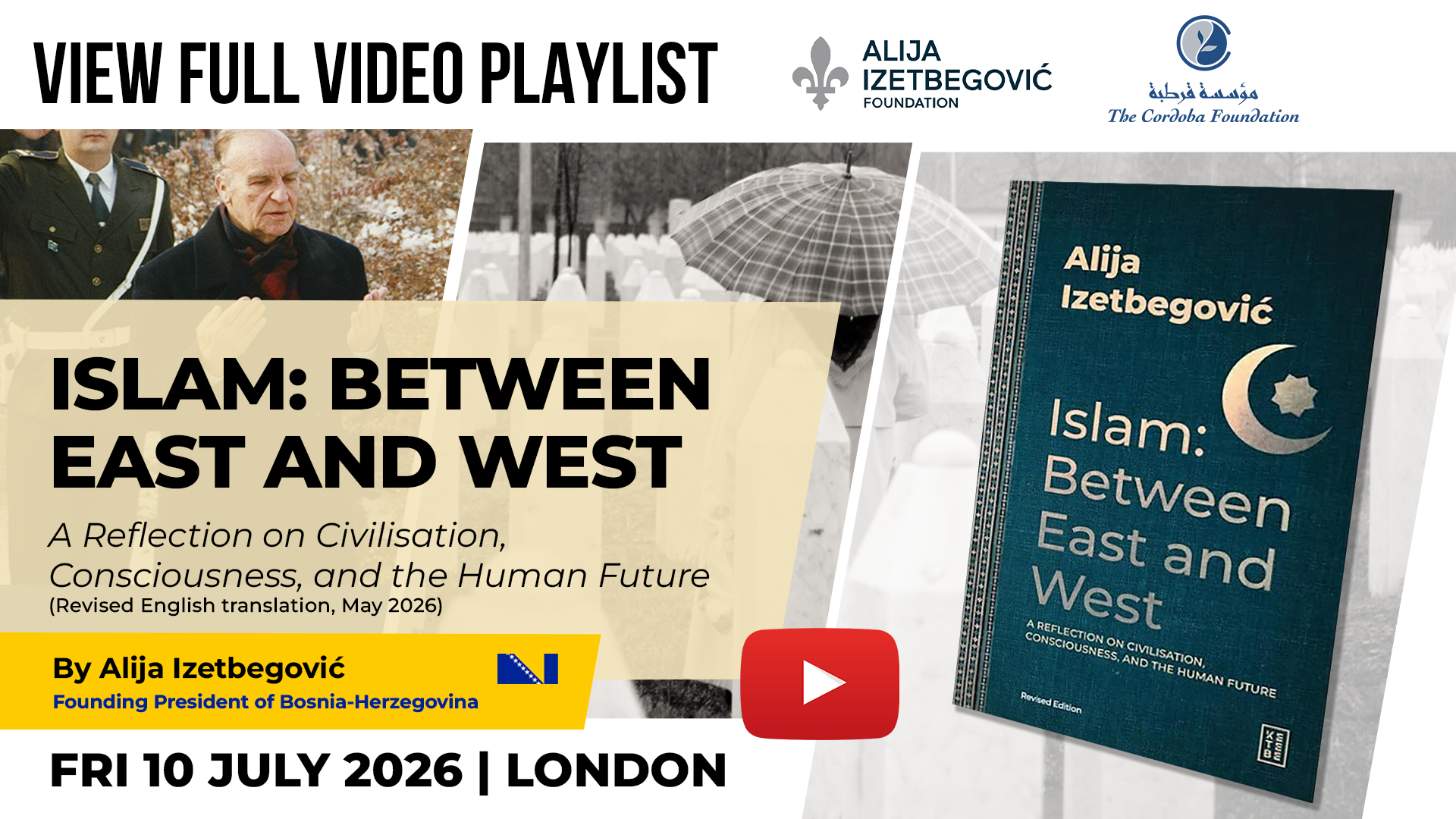
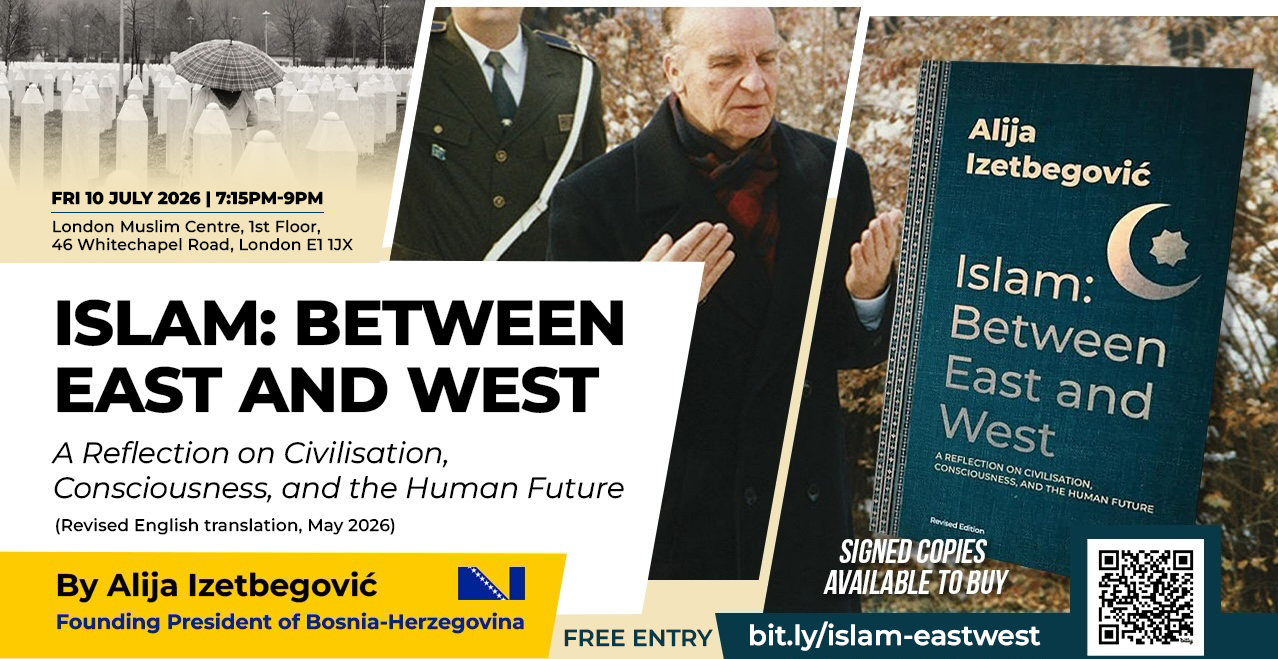
The Cordoba Foundation, with the Alija Izetbegović Foundation, will host the official launch of the revised English translation (May 2026) of Islam: Between East and West — the seminal work of Alija Izetbegović, the philosopher, statesman and Founding President of Bosnia-Herzegovina.
The launch will take place on Friday 10 July 2026 at the London Muslim Centre (7:15pm–9pm), with hundreds of guests expected.
Islam: Between East and West is a profound meditation on faith, civilisation and the human condition. Its first English edition was published in 1984, while its author, Izetbegovic, was a political prisoner, and it was followed by four further editions. The book argues that Islam offers a path between the materialism of the West and the abstraction of the East — a vision of the human being as both body and spirit. Over three decades after it first reached English readers, its questions about identity, belonging and coexistence remain strikingly current.
The book launch also marks the 31st anniversary of the Srebrenica Genocide, in which more than 8,000 Bosnian Muslim men and boys were murdered on European soil. The launch stands as both a commemoration of those lost and a reflection on what the world has, and has not, learned since. A special exhibition on the genocide will be on display during the event.
“Alija Izetbegović’s life and thought remind us that dialogue and dignity are not luxuries, but necessities,” said Dr Abdullah Faliq, Managing Director of The Cordoba Foundation and a longtime advocate for Srebrenica. “To revisit his work in the shadow of Srebrenica is to ask ourselves what kind of future we are building, and whether we have the courage to remember.”
Sabina Berberović, daughter of Izetbegović who is traveling from Bosnia to speak at the book launch, said: “During the Second World War my father was a high school student. He read a great deal, mainly philosophical and political books, and felt conflicted between communist ideas and religious beliefs. Eventually it was in his faith — Islam — that he found all the core values he was searching for; a universe without God seemed to him a universe without meaning.”
Berberović added, @Inspired by this personal journey of thought, he, just a teenager, began writing a book. He put on paper the basic structure, ideas and thoughts, and the title: Islam between East and West.”
The book launch event brings together a distinguished panel of speakers, including Izetbegović’s daughter (a founding member of the Alija Izetbegović Foundation); H.E. Osman Topčagić, Bosnian Ambassador to the UK; Shaykh Prof Abdal Hakim Murad, Dean of the Cambridge Muslim College; Dr Admir Mulaosmanović, professor and Bosnian War veteran; Shaykh Dr Yasir Qadhi (joining online); Martin Bell, the former BBC war reporter who covered the siege of Sarajevo; Sarah Joseph OBE, writer and broadcaster; and Dr Wajid Akhter, Secretary-General of the Muslim Council of Britain.
[Ends]
Notes to editors:
For media enquiries, interviews or further information, please contact: media@thecordobafoundation.com.
For event details: events@thecordobafoundation.com
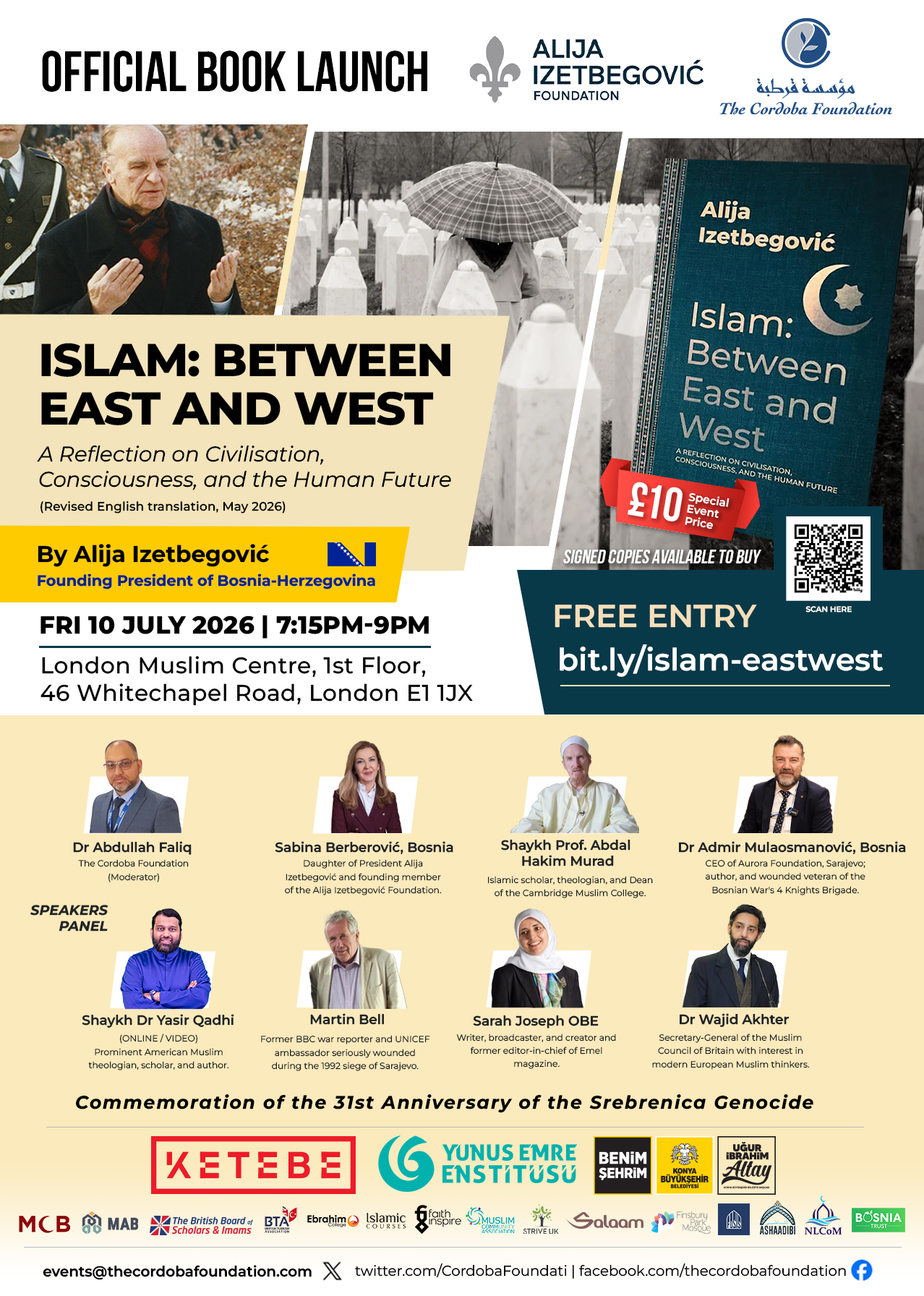
A Reflection on Civilisation, Consciousness, and the Human Future
In a world fractured by rigid religious dogma and materialist reductionism, Alija Izetbegović’s seminal work transcends binary thinking to offer a profound roadmap for modern civilisation and consciousness.
Moderator
Dr Abdullah Faliq
Cordoba Foundation
Speakers
Sabina Berberović
Daughter of President Alija Izetbegović and founding member of the Alija Izetbegović Foundation.
Prof Tim Winter (Shaykh Abdal Hakim Murad)
Islamic scholar, theologian, and Dean of the Cambridge Muslim College.
Dr Admir Mulaosmanović
Balikesir University professor, author, and wounded veteran of the Bosnian War’s 4 Knights Brigade.
Shaykh Dr Yasir Qadhi (video/online)
Prominent American Muslim theologian, scholar, and author.
Martin Bell
Former BBC war reporter and UNICEF ambassador seriously wounded during the 1992 siege of Sarajevo.
Sarah Joseph OBE
Writer, broadcaster, and creator and former editor-in-chief of Emel magazine.
Dr Wajid Akhter
Secretary-General of the Muslim Council of Britain with expertise in modern European Muslim thinkers like Alija Izetbegović.
Register to attend:
bit.ly/islam-eastwest
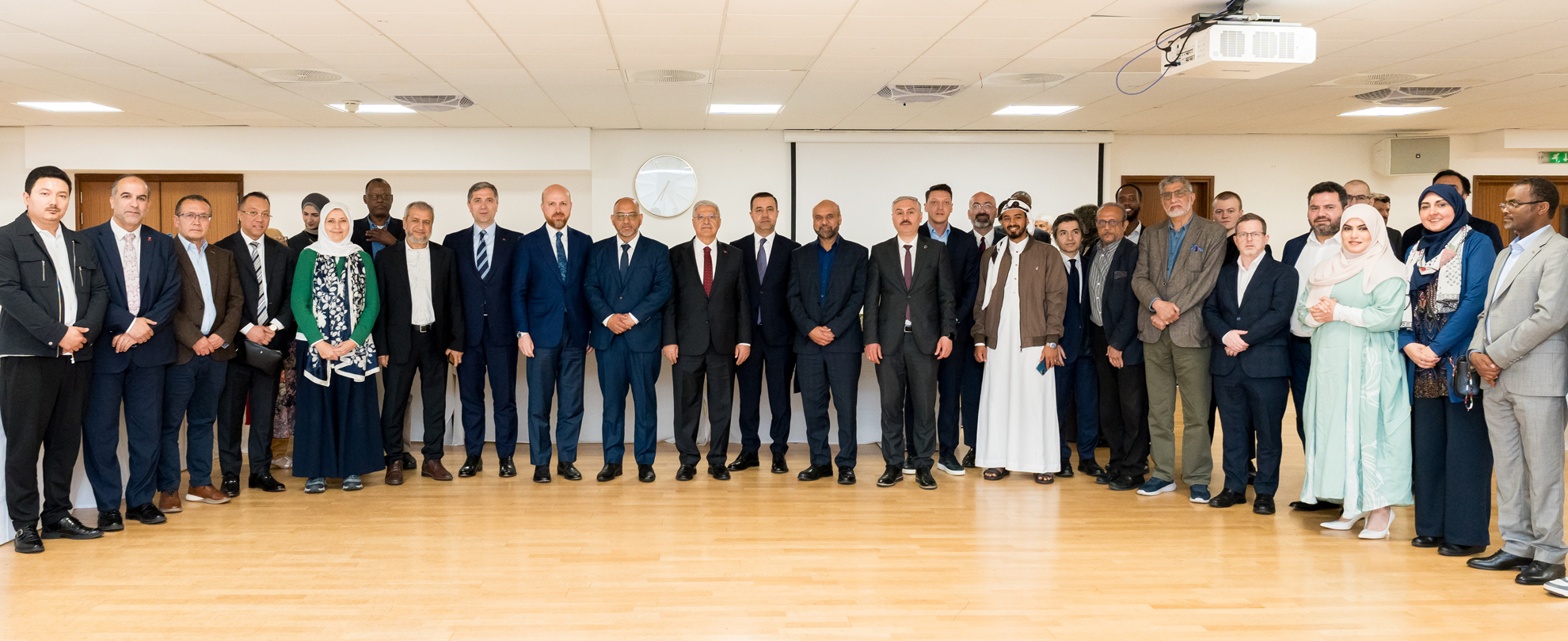
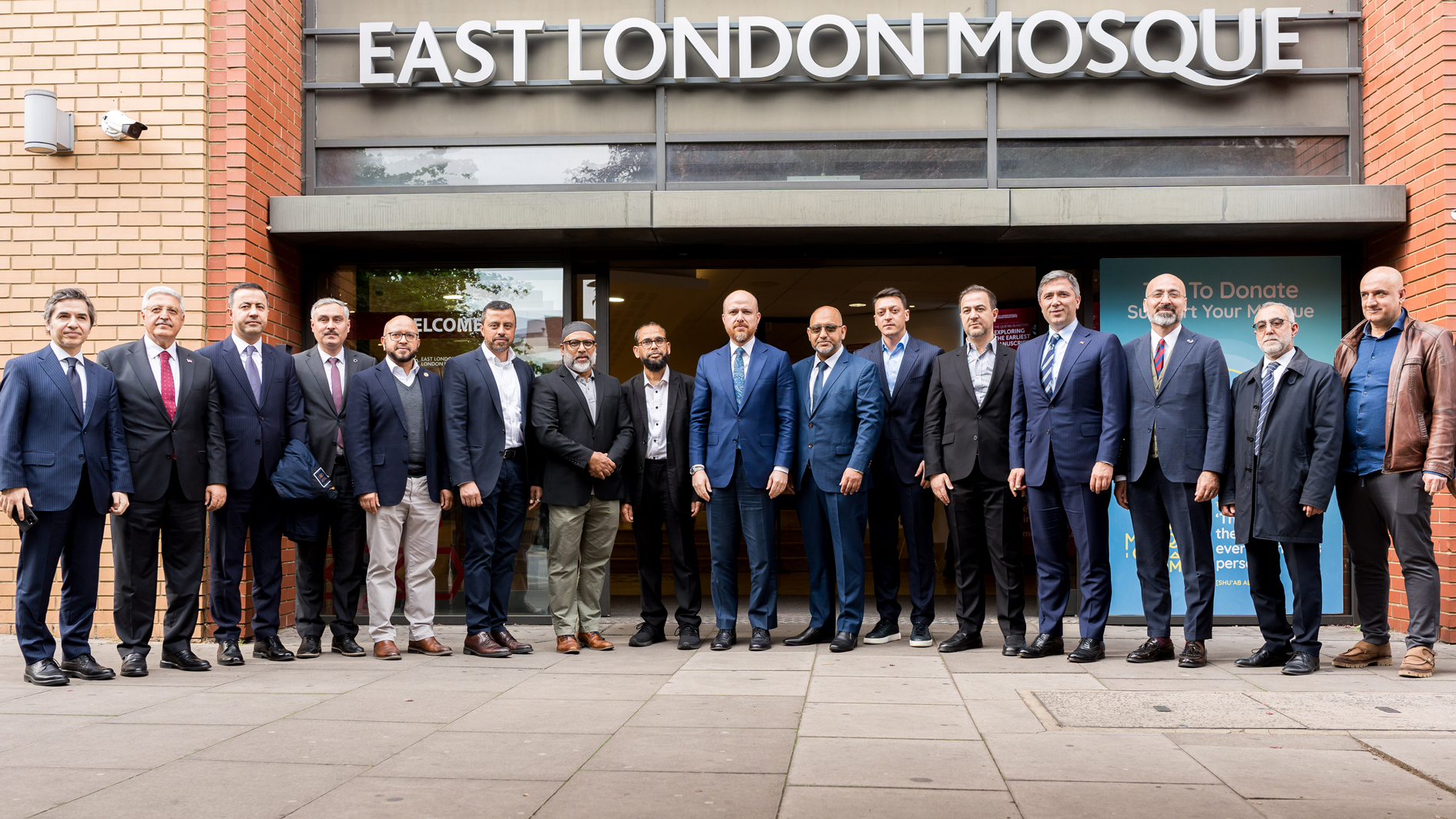
On Sunday 17 May, The Cordoba Foundation, in partnership with the Presidency for Turks Abroad and Related Communities (YTB), welcomed Bilal Erdoğan to London.
The special meeting was attended by nearly 100 Muslim leaders, reflecting the diversity of Britain’s Muslim communities. It was chaired by Dr Abdullah Faliq, Managing Director of The Cordoba Foundation and the former Policy Advisor for AK Parti UK.
Bilal Erdoğan spoke about the challenges facing Muslim communities around the world, particularly in Europe. He reflected on the achievements of the Turkish government, while acknowledging the challenges it faces.
He urged those present not to allow difficult global events to drain hope from young people, stressing that “the youth are our future”. He said young people would play a central role in shaping the world ahead.
Bilal Erdoğan also highlighted the importance of Turkish communities building stronger links with other Muslim communities as part of the wider Ummah. He noted that Turkish communities had not always been as active or open in this regard but said the rise of the far-right made connection and unity even more urgent.
He encouraged Muslim youth in the West to connect with their counterparts in Türkiye through summer camps and visits, noting that there were no visa restrictions or obstacles preventing such exchanges. Through these connections, he said, young people could share their thoughts, experiences and ideas.
The discussion covered a range of issues, including the threat of the far-right, youth and leadership, education, the needs and challenges of Muslim converts, and the genocide in Gaza.
Faliq concluded the meeting calling for greater collaboration, proactive engagement and unity.
Bilal Erdoğan was accompanied by a high-level delegation, including Ambassador Osman Koray Ertaş; Abdulhadi Turus, President of YTB; Zafer Sırakaya, Turkish MP and Chairman of Foreign Affairs for the AK Parti; German footballer Mesut Özil; Vedat Özdemir, Deputy Chairman of the AK Parti; and Mahmut Özdil, President of the Türkiye Maarif Foundation.