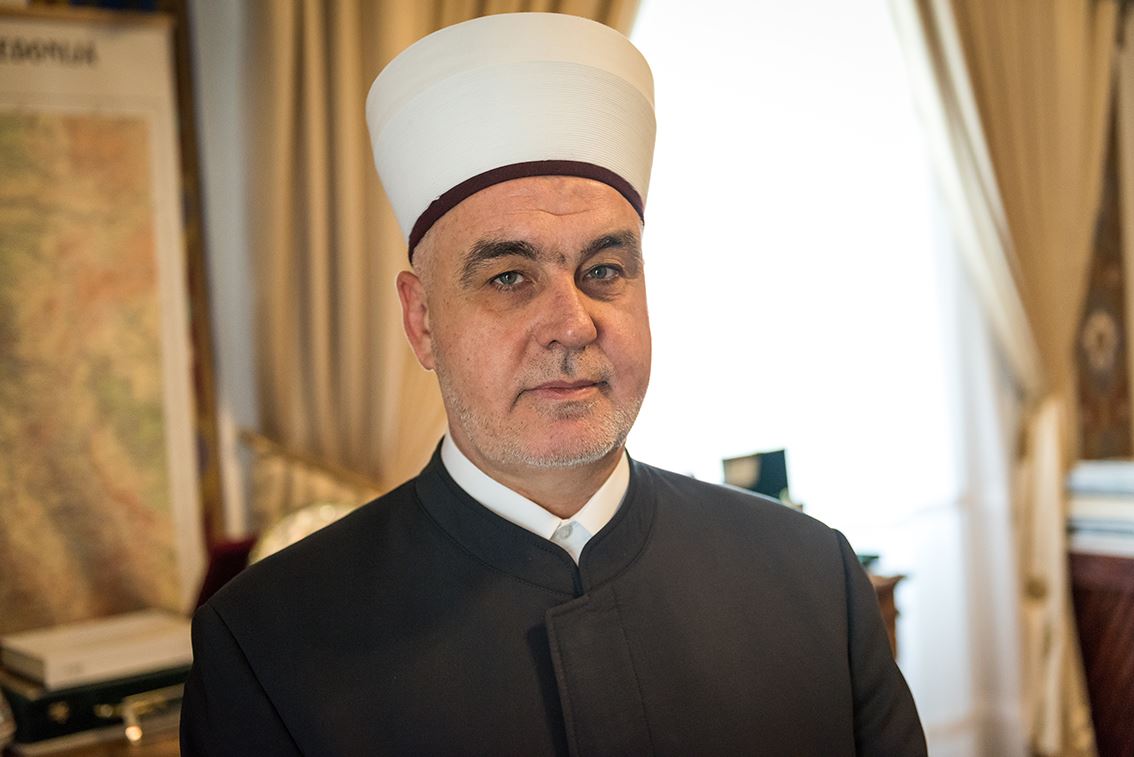
Prof Admir Mulaosmanovic CEO, Aurora Foundation, Sarajevo, Bosnia-Herzegovina
Official book launch, Islam: Between East and West by Alija Izetbegovic The Cordoba Foundation & Alija Izetbegovic Foundation 10 July 2026, London Muslim Centre
“The contemporary world is marked by a sharp ideological conflict that has been going on for years and whose end is not in sight. We are all involved in this conflict in one way or another, either as its participants or as its victims. What is the place of Islam in this gigantic confrontation? Does it have any role in shaping today’s world? This book attempts to answer that question, at least partially.”
I begin this short address with a sentence from the introduction to the book, Islam: Between East and West, which, both then and now, poses one of the key questions for Muslim thinkers and all those who take Islam as a guide in life. The thought expressed — the question that Alija Izetbegović posed—rings even more powerfully today than when it was first written down. The bipolar order that shaped his approach has ceased to exist, but the multipolar one is slowly becoming a reality that must be reckoned with, which emphasizes the need to define the role of Islam in it.
Due to this multifaceted confrontation, relations have become more complex and subtle, and the world taking shape before our eyes is both troublesome and worrying. The role of Islam in a bipolarly divided world and the Cold War environment was great, but in the most significant aspect, it remained unrealised. Today, as in the near future, this role is becoming — and will become — even more pronounced, but the possibility that it will be neglected, as it was during the twentieth century, remains a realistic scenario.
However, a repetition of the twentieth-century lethargy of Islamic thought would be worse than humiliating. The Islamic idea has become crucial not only for defining one’s own position, but also for the survival of a world in which humanity does not become a mere statistical entry or “quantified energy that produces guaranteed profit.” Instead, it offers a vision of a being imbued with meaning in the fullness of his action and existence — “a being of call and response” whose essence is fulfilled in the drama of existence. Therefore, within the dehumanising rush of the Anthropocene era that humanity has built against itself, Islam provides both a teaching and an order capable of restoring the lost meaning of anthropos by re-establishing humanity as a unique presence within theocentric discourse. Yet, in this immense new confrontation, this role must first be accepted, and then actively performed.
In this work, Izetbegović reveals the return of reality’s missing inner dimension of reality — a dimension linked to the drama of existence and the testimony of humanity’s arrival from the Unknown — by contrasting Michelangelo with Darwin. In doing so, he sharply contrasts art with science. He argues that, at its most authentic, art is the history of human alienation. This is precisely why science and art are in complete, irrevocable conflict regarding the origin and nature of humanity. Izetbegović claims that a science of humanity is possible only if man is viewed as a part or product of the external world, whereas art is possible only if man is distinct from nature — a stranger within it.
For Izetbegović, however, being a stranger means being a true individual — that is, achieving and realising the full capacity of a person. He emphasises this sense of foreignness, viewing this inner dimension of reality as the conscious meaning of existence.
For Izetbegović, therefore, this meaning is thoroughly reflected in the ultimate humanisation of the individual. Through countless examples — often defying worldly logic — he shows how this state is achieved. “Fighting for other people, or for truth, justice, and goodness, is always a negation of the narrowness and finitude of life. The sacrifices of those who lose their lives, freedom, and peace because they remain faithful to moral laws represent the most profound revelation of the infinity of life and its higher, secondary meaning. These are sparks of light that, like a flash of lightning in a dark night, instantly illuminate distant horizons for us.” This is one of the core convictions he expresses in his elaboration on what it means to become fully human.
Reading Islam: Between East and West leads to the conclusion that Izetbegović’s thought is provocative, yet primarily avant-garde. Unburdened by the traditional framework defined by the Ottoman and post-Ottoman systems of Islamic scholarship, his thought transcends these limits, ascending to higher levels of theoretical reflection on Islam and its position in a divided world. He engages in dialogue with intellectual giants, seamlessly incorporating their thoughts and ideas into an explanatory framework that establishes his own argument.
Izetbegović approached society, politics, culture, and all other topics from the position of an advocate building a system based on the Islamic worldview. This is why Islam: Between East and West is not a theological text. Izetbegović himself describes the book as “not theology, nor is its author a theologian; rather, it is an attempt to ‘translate’ Islam into a language spoken and understood by today’s generation.” This text is, therefore, a call for both individual intellectual sharpening and collective social action.
The thought of Alija Izetbegović in general, and this book in particular, should serve as a guide for Muslim intellectuals navigating “post-normal times,” precisely because it validates the necessity of establishing an Islamic worldview. Izetbegović brilliantly anchors his arguments by placing humanity at the center of the world’s drama. Across all the themes he explores—from the problem of justice and retribution to art as a spiritual flash within the human soul—the human being remains a unique phenomenon whose actions strive toward the pure meaning of existence.
Structurally, the book consists of two parts. It comprehensively analyses the problem of religion on the one hand, and the question of Islam from the perspective of bipolarity on the other. Yet, the human being remains the core, defining theme of the work. Izetbegović clearly demonstrates how materialists view man as a mere “biological machine,” arguing that the difference between humans and animals is only a matter of degree rather than quality, thereby denying the existence of a distinct human essence
To illustrate this point, he quotes György Lukács’s Existentialism or Marxism, claiming that there is only a “concrete, historical, and social concept of man” and that “economic and social history is the only one that is concrete and that really exists.” He similarly highlights Ivan Pavlov, who believed that man, like all other natural systems, is subject to the inevitable and general laws of nature. Though these positions may seem self-evident to some, Izetbegović views them as a total negation of humanity because they entirely dismiss the inner dimension of human reality.
Finally, by drawing on the philosophical insights of Jacques Derrida — who posited that there is no “view from nowhere” and, consequently, no entirely objective, unmediated knowledge — we can fully flesh out Izetbegović’s overarching thesis. Objectivity does not emerge from a vacuum of perspective, nor is it possible to remain neutral when evaluating contrasting discourses. For Izetbegović, the Islamic worldview is an ontological reality; a conviction in its truth cannot be fulfilled by theoretical formulation alone. It is an operational force meant to subdue and guide the world in the name of God and for the ultimate good of humanity. Achieving this requires immense perseverance and devotion. As Izetbegović powerfully concludes in the final sentence of his book: “O submission, your name is Islam!”
BY Husein ef. Kavazović, GRAND MUFTI AND Reis-ul-ulema OF BOSNIA-HERZEGOVINA
COMMEMORATING THE 31st ANNIVERSARY OF THE SREBRENICA GENOCIDE
Gazi Husrev Bay Mosque, Sarajevo, 10 July 2026
All praise is due to Allah, the Sustainer of the worlds, the Deliverer of the oppressed, the Helper of the believers, and the Protector of the faithful. He is the One in whose Name all things begin and all things end. I bear witness that there is no deity but Allah, the One, without partner, and I bear witness that Muhammad (peace and blessings be upon him) is His Messenger. O Allah, bestow Your mercy and blessings upon the Prophet Muhammad (peace and blessings be upon him), his noble family, and his companions.
Dear brothers and sisters in Islam, respected members of our congregations,
We find ourselves in days that, both in our collective consciousness and in the history of all humankind, carry the heaviest burden of grief, sorrow, and remembrance. Every year, the middle of July unfailingly brings us back to the valley of the river Drina, to our Srebrenica. It returns us to the martyrs’ cemetery in Potočari, where the white gravestones stand in solemn silence, yet bear powerful witness to a crime that shook the conscience of humanity – the Genocide committed against the Bosniak people within the United Nations designated Safe Area.
Inscribed within those white gravestones are our love and our grief for those dearest to us. They bear witness not only to the cruelty of the aggressor, but also to the indifference of the world. Today’s khutba is not merely a remembrance of historical dates; it is a call to perpetual vigilance, to remembrance and collective memory. For in Islam, remembering is an act of worship (ibadah), while forgetting is a danger that paves the way for the repetition of evil.
The pain and grief that we carry within us will remain with us forever, for it has rightly been said that suffering once endured can never truly be forgotten. Yet it is our duty to rise above its overwhelming weight and never allow it to break our spirit. Our faith teaches us and instils within us the strength to endure every trial with patience, even the most difficult ones. By the grace of Allah, throughout all these years we have neither lost heart nor bowed our heads before evil. We have offered a steadfast resistance that has earned the admiration of the world. We have learned how to bear the burden of the pain that was inflicted upon us. With patience and unwavering determination, we shall continue our struggle against forgetfulness, but also against hatred, ensuring that it never poisons our hearts or our souls.
Dear brothers and sisters, in the Qur’an, the Almighty Allah commands us never to conceal the truth and reminds us to bear witness against injustice. In Surat al-Mā’idah, He says:
“O you who believe! Be ever steadfast in your devotion to Allah, bearing witness with justice; and never let hatred of anyone lead you into the sin of deviating from justice. Be just; this is closest to righteousness.” (Qur’an, Surat al-Mā’idah, 5:8)
From this noble verse we learn a fundamental moral lesson: preserving the memory of the victims of the Genocide is an act of the highest justice and righteousness. It is the fulfilment of Allah’s explicit command to bear truthful and just witness. We remember Srebrenica in order avoid nurturing hatred, but to ensure that truth prevails over falsehood and that such evil never again happens to anyone, anywhere.
We, the Bosnian Muslims, have learned, perhaps more than any other people in the world, that the paths of hatred lead only to death, despair, and the corruption of the human soul. Upon the mythology of blood and soil, nothing can be built except misery and crime. Those who forget that the Earth and all that it contains belong to God, and that all of His creation is equal in dignity, stand only one step away from committing atrocities.
Srebrenica teaches us that evil never rests. We live in a time marked by the growing and institutionalised denial of the crime of Genocide. The proponents of evil make enormous efforts to minimise the crime they committed and to erase the distinction between the perpetrator and the victim. They believe that lies can cast doubt upon established historical facts. They deliberately count on our weariness, hoping that we will eventually yield to their brazen lies.
For this reason, the culture of remembrance and memory must never be confined to a single day of the year or reduced to a mere expression of mourning. It must become an integral part of our daily identity, our educational system, and the upbringing of our families. It is our moral duty to pass the truth on to our children, not to burden them with hatred, but to equip them with vigilance and the awareness that evil never rests.
It is for this reason that the Messenger of Allah, Muhammad (peace and blessings be upon him), teaches us in the well-known hadith narrated by Abu Hurayrah (may Allah be pleased with him):
“A believer must not allow himself to be stung from the same hole twice.” (Ṣaḥīḥ al-Bukhārī and Ṣaḥīḥ Muslim)
This hadith constitutes the religious foundation of our culture of remembrance, as well as our direct obligation to prevent Genocide. The prevention of Genocide is not merely a political or legal issue; it is, above all, a profound religious and moral obligation. We have no right to be naïve. Prevention means recognizing the early signs of evil, dehumanisation, and denial before it is too late.
In this context, the adoption of the United Nations Resolution on the Srebrenica Genocide represents on the global scale an important civilizational milestone. This Resolution is a clear indication that the international community, despite its delayed response, has established both a legal and a moral barrier against falsehood and denial. Yet international resolutions provide only a framework; genuine prevention begins within our homes, our congregations, and our institutions.
Our daily commitment to education, vigilance, and the preservation of truth within our local communities and congregations constitutes the essential first line of defence against the repetition of the past.
If we surrender to complacency and the comfort of forgetting, we risk experiencing again the horrors endured by our fathers, our grandfathers, and our sons. Our history in this land reminds us that every act of historical forgetfulness has served as a prelude and invitation to new crimes against us. Negligence and indifference are luxuries we can never again afford. Remembering Srebrenica, and actively working to prevent the recurrence of evil, are the very pillars of our survival and our continued existence in our ancestral homeland.
The Genocide committed in Srebrenica obliges us to think vigilantly and responsibly about the future of our people and of our Srebrenica. Almighty Allah says:
“Allah has promised those among you who believe and do righteous deeds that He will surely cause them to accede to power on earth …” (Qur’an, Surat En-Nur, 24:55)
We believe with certainty that God‘s promise is true. At the same time, we are equally convinced that much depends on us today. It is our duty to care for Srebrenica, for it is the birthplace of our collective suffering. Nothing in this Bosnian country can be compared to it. We prevent genocide by strengthening our institutions, by striving for excellence in education, scholarship, and economic development. Our strength, together with our readiness to defend ourselves and safeguard our right to life, is the greatest deterrent against any future evil. It is our responsibility to persevere, to invest in knowledge, and to secure a dignified and safe life for all the people of Srebrenica and its surrounding region. Those who take God as their Protector and remain steadfast in faith and endeavour will attain what they seek.
Islam is a religion of honour, dignity, and steadfastness; a religion of truth and justice. Therefore, let not grief cast us into despair, nor compassion into weakness. Allah tests us in good times and in bad times, in abundance and in hardship, and our steadfastness is measured by our unity.
The Qur’an tells us that Allah loves those who strive in His cause, standing together in ranks as solid as a fortified structure. Let us therefore stand together as one soul and one body. Let Srebrenica remain for us an everlasting lesson that the weak, the divided, and the unprepared cannot expect mercy. And let it be our solemn pledge that, by strengthening our unity and our collective resilience, we will ensure that such suffering is never inflicted upon us again. Raise your hands in supplication morning and evening – and call upon your Lord.
O Lord, to You we raise our hands. You are the One who knows the whisper of every heart and the only true remedy in the midst of despair. Help us heal our wounded souls and grant us everlasting peace in Your presence.
O Lord, bestow Your blessings upon the people of Srebrenica and upon their descendants for all generations to come.
O Lord, grant us the wisdom, the strength, and the unity to recognise and prevent every evil that may threaten us. Preserve the memory of Srebrenica in our hearts for all eternity. May Srebrenica forever remain the pledge of our freedom, our unity, and our life in peace. By Your Majesty and Your Infinite Mercy.
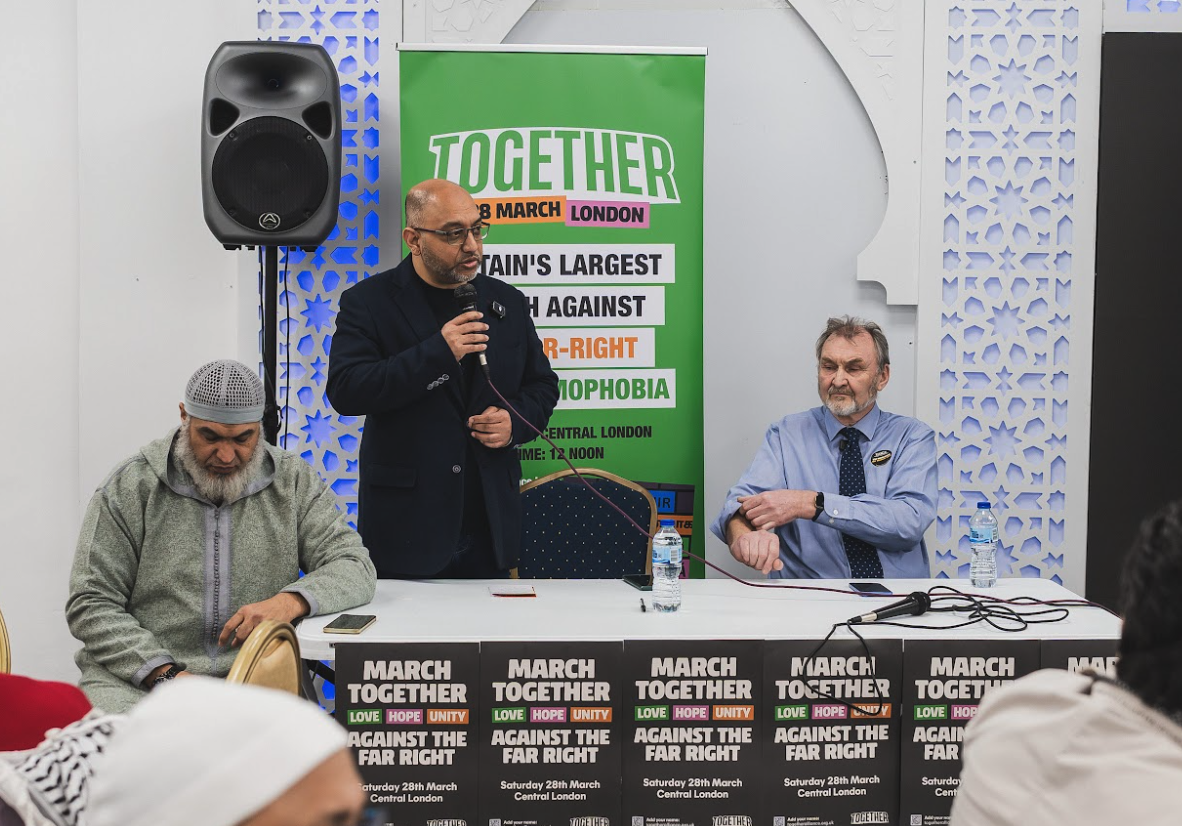
People of different faiths and none gathered in London last week for the Together Alliance Iftar, in what organisers described as a collective stand against the Far-Right and rising Islamophobia.
Around 200 guests attended the event, including representatives from major British Muslim organisations, advocacy groups and leading pro-Palestine campaigners. Those present reflected a broad cross-section of communities in London.
Dr Abdullah Faliq, managing director of The Cordoba Foundation and a member of the Together Alliance steering committee, moderated the event and opened proceedings by thanking participating organisations for their support and contribution to the alliance.
He also warned about the dangers posed by growing Islamophobia and the rise of far-right politics in Britain.
“Our inaction at a time of heightened Islamophobia and a surge in the Far-Right will have severe consequences for the entire community – and for generations to come,” said Faliq. “Unchecked racism and Islamophobia can lead to mass persecution as we tragically learned in the case of the Srebrenica genocide in Bosnia in 1995.”
Referring to the history of anti-fascist resistance in east London, Faliq added: “As we mark the 90th anniversary of the Battle of Cable Street, halting the march of Oswald Mosley’s Blackshirts (a quasi-military fascist group of thugs, modelled on Mussolini’s Squadrismo), we need to learn lessons, so history doesn’t repeat itself.”
Faliq stressed that while Mosley’s Blackshirts had targeted and scapegoated Jews in the past, today’s Far-Right movements were turning Muslims into their main target. He named the English Defence League, Britain First and UKIP among the groups pursuing what he described as the same politics of hate.
“The far right’s growing political momentum should concern everyone, particularly given the possibility of it entering government,” Faliq continued, stressing that this was a moment for urgent and proactive action rather than passivity. He described the Together Alliance national demonstration on 28 March as a necessary response.
Kevin Courtney, chair of the Together Alliance and former joint general secretary of the National Education Union, delivered the keynote address. He spoke about what he saw as both the international and domestic threat posed by the Far-Right.
“We see the threat of the Far-Right in power in the US — in relation to Gaza, Venezuela, Iran and Cuba. But it is not just a matter of foreign policy. We also see it domestically, with ICE in Minneapolis claiming to focus on ‘illegal’ migrants, while black and brown people are being arrested,” said Courtney.
Despite the seriousness of the threat, Courtney said there was still reason for optimism if communities organised together. Drawing on earlier examples of collective resistance, he pointed to the defeat of the British Union of Fascists at Cable Street in 1936 and said communities in Tower Hamlets had also pushed back against UKIP.
“We said they shall not pass and we meant it,” Courtney added. “But the threat now is very real both from Tommy Robinson and from political parties. They attracted around 100,000 with vile rhetoric and Islamophobia, calling for remigration and so on.”
Courtney also cited what he said were examples of anti-Muslim rhetoric by public figures abroad. He alleged that Belgian Far-Right politician Philip Dewinter had said: “Islam is our real enemy, we have to get rid of Islam. Islam does not belong in Europe and Islam does not belong in the UK.”
He further added that Brian Tamaki, leader of New Zealand’s Destiny Church, had said: “Islam, Hinduism, Baháʼí, Buddhism — whatever else you’re into — they’re all false. We’ve got to clean our countries up. Get rid of everything that doesn’t receive Jesus Christ. Ban any public expression of other religions in our Christian nations. Ban halal. Ban burqas. Ban mosques, temples, shrines — we don’t want those in our countries.”
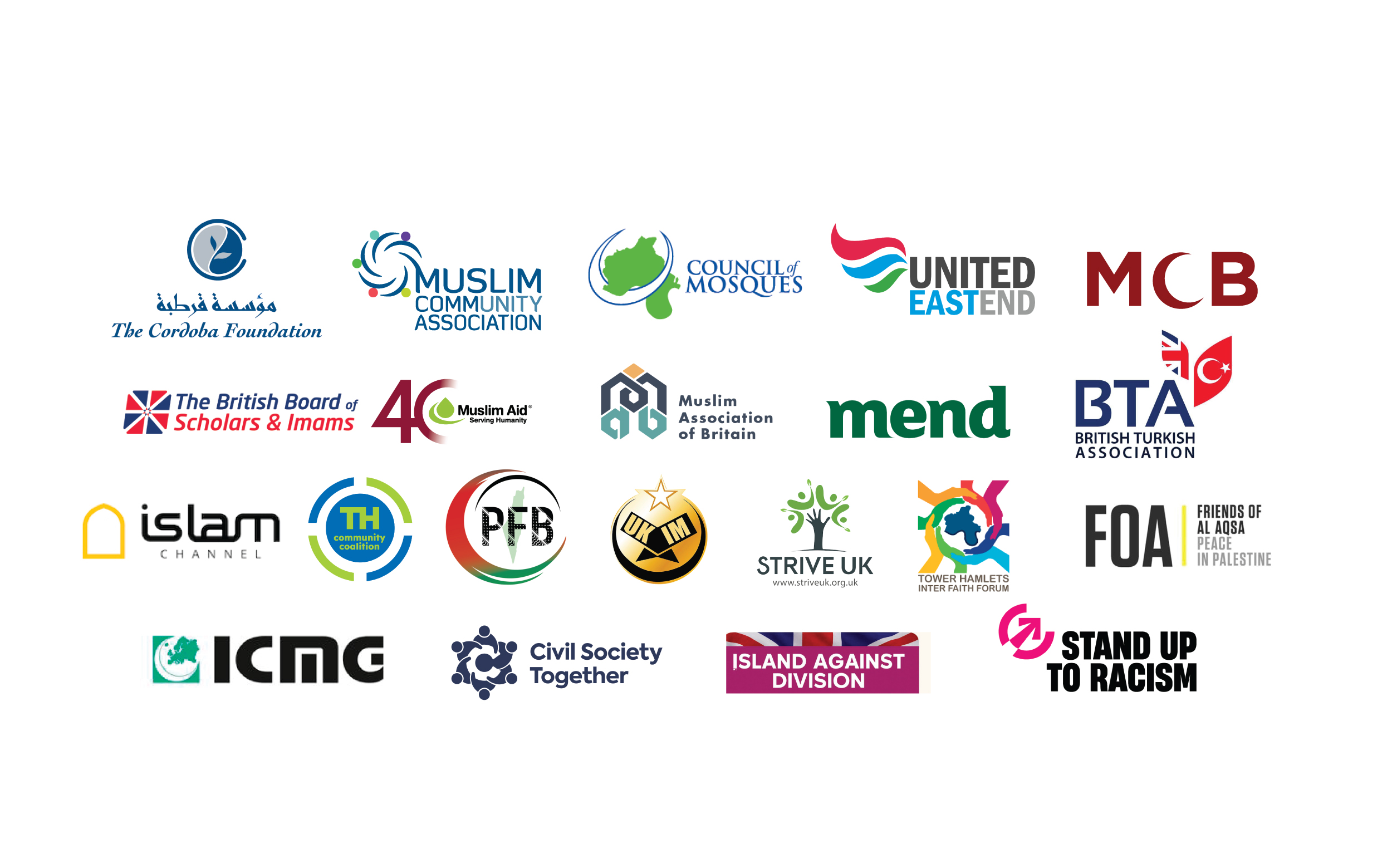
Courtney said the answer to such politics lay in broad-based unity. Praising the growth of the coalition, he said: “We started with three or four unions and the Palestine coalition including The Cordoba Foundation and the Muslim Council of Britain, led by Dr Abdullah Faliq. Now we have over 430 organisations, almost all the unions represented including nurses, midwives, teachers, faith groups, Christian Muslim and Jewish orgs and NGOs (eg. Amnesty, Greenpeace, Friends of the Earth).”
Maswood Ahmed, deputy secretary-general of the Muslim Council of Britain, also addressed the gathering. He repeated concerns over the rise of the Far-Right and increasing Islamophobia, while stressing the value of collaboration and coordination at a time of growing pressure on communities. Ahmed also highlighted the work of the Muslim Council of Britain and encouraged wider support for the Together Alliance.
Shamiul Joarder, speaking on behalf of Friends of Al-Aqsa, issued a direct call to action. “We know the threat; we know the problem but what are we going to do about it?” he asked. “We must take this seriously as this will affect each and every one of us here. The Together national demo should be our priority, let’s mobilise for the 28th of March.”
Dilowar Khan, from the Muslim Community Association, also urged collective action. “Now is the time to work together as the consequences of our inaction will be grave,” he said.
Other speakers from United East End, Stand Up To Racism, Palestine Forum in Britain and the British Turkish Association echoed the call, urging mosques and communities across the UK to mobilise for the Together demonstration on 28 March in central London.
The Together Alliance describes itself as a coalition of hundreds of civil society, faith and community organisations representing more than seven million people. Organisers say the 28 March demonstration is expected to be Britain’s largest protest against the far right and Islamophobia.
The Cordoba Foundation welcomes efforts to confront rising Islamophobia in the UK and affirms that a clear and effective definition is essential for promoting genuine equality, social cohesion and mutual respect.
As an organisation committed to dialogue and peaceful coexistence, we recognise that British Muslims continue to face hostility and discrimination across many areas of daily life. Such realities must be fully acknowledged in any definition seeking to combat the rise of Islamophobia.
We are therefore concerned by suggestions that the government may adopt a weakened definition that fails to reflect the structural and racialised nature of Islamophobia.
Diluting this understanding risks undermining the very communities such a definition is meant to protect.
For any definition of Islamophobia to be effective, it must command genuine legitimacy among the communities most affected. This requires a transparent process that listens to and reflects the lived experiences of British Muslims. Community buy-in will only be achieved if the definition recognises the full spectrum of anti-Muslim prejudice, including its structural and racialised dimensions, and provides clarity for institutions tasked with addressing it.
We urge the government to work closely with Muslim communities and civil society partners to ensure that the definition is robust, inclusive and capable of guiding real action against anti-Muslim prejudice.
Australian Muslim of Syrian descent, Ahmed Al Ahmed did not pause for a moment when he saw innocent civilians being horrifically targeted by shooters.
He did not wait to assess local or global politics, he did not choose to take a back stand approach and watch fellow humans being massacred- his natural instincts called for him to respond and disarm one of the shooters- despite himself being injured from 2 gunshot wounds sustained.
Had it not been for his swift humane decision to intervene despite the HUGE risks to his own life, only God knows how many fatalities and injuries we would have witnessed.
I hope people reflect on this genuine moment of heroism and humanity and understand that this is how most people- humans – would respond, regardless of faith or ethnicity.