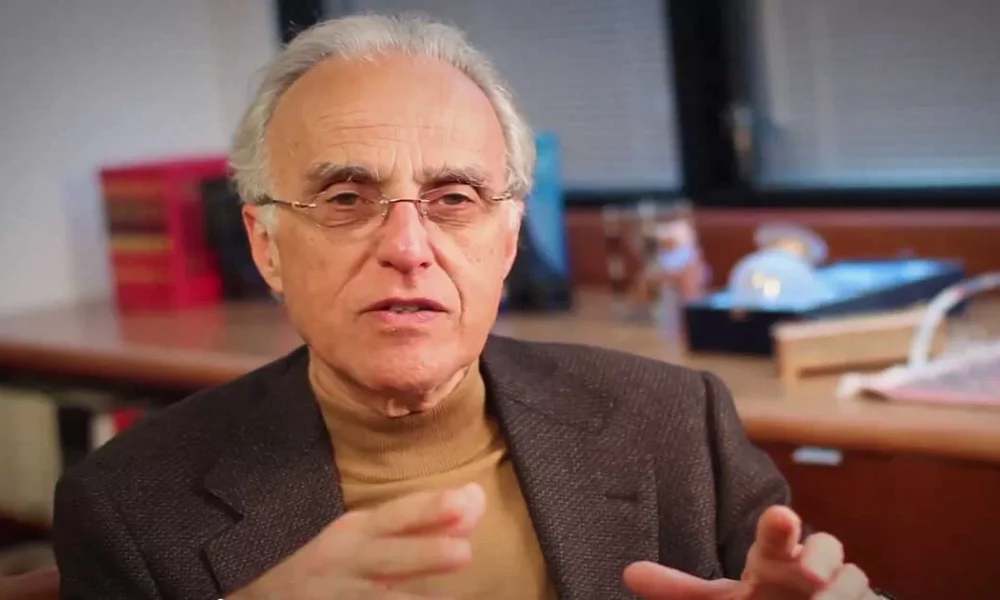
The Cordoba Foundation mourns the passing of Professor John L. Esposito, who died on July 15, 2026, at the age of 86, following complications from heart surgery. With his passing, the world has lost one of the most consequential scholars of Islam of the past century, and we have lost a cherished friend.
John Esposito’s relationship with The Cordoba Foundation went back to our earliest days. From day one, he was not only a friend and a supporter but an intellectual giant who had the humility and grace to seldom, if ever, turn down an invitation to contribute in any way asked of him. Whether it was a lecture, a foreword, a quiet word of encouragement, or simply lending his name and his considerable moral authority to a cause he believed in, John gave generously of his time and his standing. That he did so without pretension, and often without needing to be asked twice, said as much about his character as his scholarship did about his mind.
Born in Brooklyn in 1940 and originally on a path toward the Catholic priesthood, Esposito instead built a career that would see him become university Professor of Religion, International Affairs, and Islamic Studies at Georgetown University, where in 1993 he founded the Prince Alwaleed bin Talal Center for Muslim-Christian Understanding.
Over more than five decades, he authored, co-authored, or edited upwards of fifty-five books, many published by Oxford University Press and translated into dozens of languages, becoming standard references on Islam in universities around the world.
He served as president of both the Middle East Studies Association of North America and the American Academy of Religion, and was honored with the Academy’s Martin E. Marty Award for the Public Understanding of Religion as well as Pakistan’s Quaid-e-Azam Award for Outstanding Contributions to Islamic Studies.
But numbers and titles only tell part of the story. What set John apart was the moment in which he chose to do his most vital work. At a time when Muslims around the world, but particularly in the West, were under immense pressure in the aftermath of the September 11 attacks, John debunked the accusations, falsehoods, myths, and lies in language that few could better. He argued calmly and often humourously, but always with irrefutable evidence, with decades of scholarship, and with a clarity that cut through the noise of fear and suspicion that had come to define so much of the public conversation about Islam. He understood that the battle against Islamophobia would not be won with slogans, and so he built institutions instead: the Center for Muslim-Christian Understanding, and later the Bridge Initiative, a research project dedicated to tracking and challenging Islamophobia with the same rigour he brought to everything else.
This was, in many ways, the defining feature of John’s life’s work: he refused to let Islam be turned into an enemy, even and especially when it was politically convenient to do so. He built bridges between Muslims and the societies around them at a time when so many were intent on building walls. He did this as a non-Muslim scholar whose credibility rested precisely on the fact that his conclusions were rooted in serious study rather than advocacy, which is what made his voice so difficult to dismiss and so essential to have on our side.
Those of us who worked alongside him remember not just the eminent professor but the man: warm, approachable, endlessly patient with young researchers and community organisers alike, and possessed of a generosity of spirit that never seemed to run out. He treated an invitation from a small foundation with the same seriousness he brought to an audience with heads of state. That, perhaps, is the rarest kind of greatness.
John is survived by his wife, Jean, and by a legacy carried forward in the shelves of scholarship he leaves behind, in the students he trained, and in the countless people, Muslim and non-Muslim alike, whose understanding of one another he helped shape for the better.
The Cordoba Foundation extends its deepest condolences to his family, his colleagues at Georgetown, and the many communities around the world who considered him a friend. We were fortunate to count ourselves among them.
Dr Anas Altikriti.
CEO & Founder
Dr Abdullah Faliq
Managing Director