Aug 21, 2009 | News & Press
Dear Brothers and Sisters in Faith and Humanity
As-Salaamu ‘Alaykum Wa Rahmatullah (Peace and Blessings be Upon You)
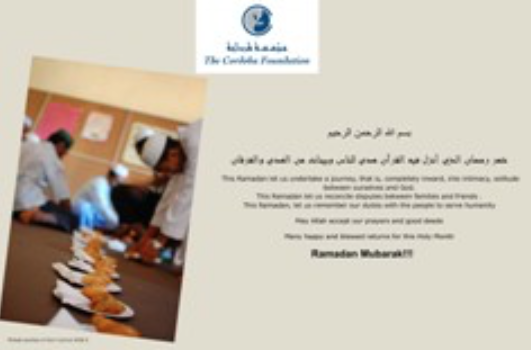
As the blessed month of Ramadan knocks at our door, we would like to congratulate you on this Holy Month.
We are all travellers on the same path, struggling to seek Allah’s pleasure. The price to acquire the traits of self control, serenity, awareness and respect of the other is a permanent personal battle against our innermost evil desires. Death, life, experiences, ordeals, pain, solitude, joy and happiness, are lessons to be learnt and taught on this journey.
The most beautiful and the most difficult lesson to be learnt on this journey? That our final destination is to find Allah and that can only be done by reconciling with the deepest level of our being (al-fitra) – the original light that Allah breathed into our hearts. Thus the secret of life is hidden in the place from which you set out.
A wise man once said, ‘Between stimulus and response there is a space. In that space lies our freedom and power to choose our response. In those choices lie our growth and happiness.’
Such is the meaning of profound spirituality. We are responsible for the actions we take and within these actions there is a reminder. For within this space, there is God and one’s heart, as the Qur’an reminds us: “…and know that [the knowledge of] God lies between the human being and his heart.”
Hence within this space everyone is asked to take up a dialogue of intimacy, sincerity and love with The Most-High. Within this space is the horizon of all spirituality requiring man to acquire a force of being and doing, rather than to undergo despotic relentlessness of a life reduced to mere instinct. Within this space, we marry the purpose of our existence with the purpose of our subsistence.
The Holy Month of Ramadan enables us to rediscover and reform this space whilst soothing one’s heart close to the recognition of the Creator. Close to the awareness of The One is the comprehension of the message of the Qur’an, its words and inspirations. To serve humanity with the higher purpose of peace and equity… To awaken your conscience in the proximity of the wounds and the injustices people face… To move away from bad thoughts and the darkest dimensions of one’s being.
At the heart of our consumer society, where materialism and individualism drive our daily lives, the Blessed Month of Ramadan reinforces our personal effort and commitment, invites us towards the deep horizons of introspection and meaning, reminds us of silence,
restraint and remembrance, and inculcates the importance of detail, precision, rigour and discipline of practice.
The Blessed Month of Ramadan is a feast of the faith of fraternal atmosphere that is shared with all brothers and sisters, to portray the humility and compassion of the Prophet (Peace be Upon Him) towards the downtrodden and distressed, irrespective of culture and creed. Ramadan is about realizing a prophetic vision of a just world and reflecting it in our mindset, etiquette, and actions, so that we become 21st century ambassadors of the Prophet (Peace be Upon Him): advocating justice, compassion and love; reminding ourselves of the role he played in promoting education, entrepreneurship, caring for the elderly, caring for people with disabilities, love for the people of other faiths, and caring for the neighbor.
So this Ramadan let us undertake a journey, ‘a journey back to the beginning’; a journey that is, completely inward, into intimacy, solitude between ourselves and our self – in the place where there is no longer anyone but God, and our self. This Ramadan let us reconcile disputes between families and friends as a sign of the remembrance of God. This Ramadan, let us strive to reinforce this remembrance of God and to remember our duties with the people, for to be with God is to be with the people. This Ramadan let us not only journey into intimacy and solitude within our self, but inculcate our responsibility as creations of God to serve humanity
Ramadan Mubarak and many happy returns
Mar 3, 2009 | News & Press
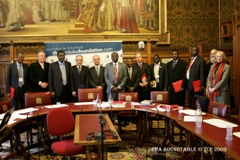
A high-level roundtable convened at the House of Lords on 26 February, commemorated the 4th Anniversary of the signing of the Comprehensive Peace Agreement (CPA) in The Sudan. Hosted by The Cordoba Foundation and Baroness Uddin, the roundtable provided a meeting point of diverse viewpoints, to analyse and assess the positive outcomes as well as the challenges that have emerged in the signing of the January 2005 Comprehensive Peace Agreement in The Sudan.

Baroness Pola Uddin opened the proceedings stating “this was a very worthwhile meeting of experts, analysts, diplomats and people concerned with peace and dialogue in The Sudan”. Before congratulating The Cordoba Foundation for staging the event, she paid tribute to Lord Nazir Ahmed – who due to unfortunate circumstances could not be present at the meeting, for his contribution to furthering stability and peace in The Sudan and for initially sponsoring the roundtable.
Guest speakers addressed a range of issues, including the Comprehensive Peace Agreement as a model for the future, the links between the CPA and the Darfur Peace Agreement and the role of the International Criminal Court.

The Sudanese Ambassador in Britain H.E. Omer Siddiq welcomed the discussion which he said “was a step in the right direction and The Cordoba Foundation and Baroness Uddin ought to be applauded for this”. Other speakers included Ex-Minister of Sudan Foreign Affairs Dr Lam Akol who is also a member of the pre-dominantly Christian SPLM; former minister Dr Ghazi Salahuddin, who is Advisor to the Sudanese President and leader of the Majority in the Sudanese Parliament; Peter Jones from Eversheds Law Firm in the UK and Dr Khalid al-Mubarak, Media Counsellor at the Sudan Embassy in London.
Anas Altikriti, the Chief Executive of The Cordoba Foundation and moderator of the roundtable, concluded the meeting by thanking the sponsor as well as the Sudan Embassy in London for their support and stated that “there were important insights in to the various peace initiatives in operations and we hope we can further the spirit of peace dialogue and understanding in The Sudan and beyond.

Feb 23, 2009 | News & Press
A high-level roundtable is to be convened this week at the House of Lords to commemorate the 4th Anniversary of the signing of the Comprehensive Peace Agreement (CPA) in The Sudan.
Convened by The Cordoba Foundation and Lord Nazir Ahmed of Rotherham, the roundtable will be a platform to highlight the positive outcomes as well as the challenges that have emerged in the signing of the January 2005 Comprehensive Peace Agreement.
Dr Khalid al-Mubarak from the Sudan Embassy in London said “this will be a milestone event as we seek to analyse the performance of the Sudan government vis-à-vis the various peace initiatives, chiefly the Comprehensive Peace Agreement, the Darfur Peace Agreement and the International Criminal Court.”
Keynote speakers at the event will include Lord Nazir Ahmed of Rotherham, the Sudanese Ambassador in Britain H.E. Omer Siddiq, Ex-Minister of Sudan Foreign Affairs Dr Lam Akol who is also a member of the pre-dominantly Christian Sudan People’s Liberation Army (SPLA), and former minister Dr Ghazi Salahuddin, who is Adviser to President Bashir and leader of the Majority at the National Assembly of Sudan.
Lord Nazir Ahmed said “I am happy to co-host such an important event, which seeks to further peace, reconciliation and dialogue at a time when hostility and confrontation seem to loom large.”
Anas Altikriti, the Chief Executive of The Cordoba Foundation and moderator of the roundtable welcomed the convening of what he called “an important event” to “discuss critically the achievements of the CPA and areas for improvements.” He added that “The Cordoba Foundation seeks to promote dialogue and understanding between civilisations, cultures and people.” As such, he added, “we hope to see what lessons we could learn from the signing of the Comprehensive Peace Agreement and how others may take this as a model for conflict resolution in different parts of the world.”
[Ends]
Apr 24, 2008 | News & Press
VOTE ON MAY 1st FOR SOCIAL COHESION AND POSITIVE ENGAGEMENT
London is one of the largest cities in the world, with communities from diverse backgrounds. The size of the capital means that some decisions about services and the capital’s development need to be taken with a city-wide view. This is the role of the Mayor. On May 1st Londoners will have the opportunity to exercise their democratic choice, by voting for the Mayor of London and London Assembly Members.
The Cordoba Foundation is concerned that the fascist British National Party (BNP) stands a real chance of having candidates elected to take part in running London. “The presence of open racists and Islamophobes in the government of our city would generate a climate of fear, suspicion and division between communities”, said Anas Altikriti, Chief Executive of The Cordoba Foundation.
“We are encouraging all Londoners to come out and vote, for competent, just and principled candidates. It is important those who aspire to run London have some track of supporting social-cohesion and positive engagement as opposed to espousing for a clash,” added Altikriti.
The Cordoba Foundation urges everyone to stop the BNP from gaining seats in the London Assembly by turning out in big numbers to vote on May 1st.
[End]
Nov 16, 2007 | Views
The prime minister’s statement on Wednesday that terrorists could strike anywhere, at any time, hardly provides any useful information, let alone induces confidence in the government or security agencies actually knowing what threat they claim to be facing or capable of successfully overcoming.
Please click here to read more
Oct 24, 2007 | Views
One of the most interesting – often intriguing – aspects of any conflict is the role of language in either calming or inflaming feelings of apprehension, division, fear and hatred that lie between the conflicting parties. In the aftermath of 9/11, the world was introduced to the term “terrorism” and “terrorist” under a new definition – a considerably vague and loose one. Suddenly, the whole world seemed to be engulfed by, or engaged with the “war on terror” in one way or another. Parties on opposing sides of the same conflict would each claim to be fighting terrorists and waging war against terrorism. This evolved to include terms such as radicalism, fundamentalism and extremism, and the impact was to spread the net of suspicion and animosity much further and wider than was allowed by the term “terrorism”
Jul 2, 2007 | Views
Reading Hassan Butt’s piece in the Observer, “My plea to fellow Muslims: you must renounce terror”, I couldn’t help but think of how much his likes have to do with the dire security conditions we all face today. Despite his claim to have repented, I would ask to be forgiven for being less than sympathetic and congratulatory in my tone, as it was probably he and his comrades who stood outside mosques, community centres and lecture halls, heckling and, at times, physically attacking me and my colleagues for talking about the need for dialogue, for reaching out to all human beings and about promoting universal human rights that include all people, regardless of faith, race or colour.
Click here to read more
Apr 24, 2007 | Views
When I first heard that someone had shot and killed 32 people on an American university campus, the first thought that came to mind was: Please God, let it not be a Muslim! By the time the full details of the horrific tragedy unfolded, it was clear that he wasn’t, although a brief moment of dread emerged when the shooter was described as Asian.
Of course to the victims of that massacre on that campus in Virginia and to those who loved and knew them, it wouldn’t have mattered one way or another what faith the killer followed, which nationality he belonged to or what ideology, if any, he subscribed to.
Click here to read more
Oct 20, 2006 | Views
When a BBC online worldwide poll shows that a third of 27,000 respondents believed some degree of torture was acceptable when dealing with terrorist suspects, we should be seriously concerned.
That so many people from 25 countries can even begin to think that such methods can be of any tangible use in combating terrorism or any other crimes the world may be facing, is worrying, and should make us reflect on where we have arrived at as a human race and what we have become. It’s notable that among the highest rates of those who thought torturing suspects was acceptable or of benefit, were in the US (36%) and Israel (43%), with 24% of those polled in the UK agreeing.