Video: Head to Head with Tariq Ramadan
The CEO of The Cordoba Foundation, Dr Anas Altikriti, recently appeared on Al Jazeera English’s ‘Head to Head’ with Prof Tariq Ramadan, speaking on ‘Has Political Islam Failed?’

The CEO of The Cordoba Foundation, Dr Anas Altikriti, recently appeared on Al Jazeera English’s ‘Head to Head’ with Prof Tariq Ramadan, speaking on ‘Has Political Islam Failed?’
Is the Arab Spring dead? Certainly not according to Dr Anas Al Tikriti, the British-Arab founder of Cordoba Foundation, who was one of the panelists on 20 March 2014 at the Skeel Lecture Theatre (Queen Mary University of London). Dr Anas came to prominence in the UK when he participated in mobilisation for the historic “Don’t Attack Iraq” march in London ( March 03).
In a forceful presentation he argued that the Arab Spring was a process not an isolated event. As such it is bound to have ups and downs; but its line of movement is now irreversible. The people can’t be subdued by force. They no longer fear their rulers and know that change is possible. The struggle for democracy deserves Western democratic support and Solidarity. He mocked the myth that people in the Arab countries deserve and need only authoritarian rule. Poverty has nothing to do with the new awareness.
To read more, please click here
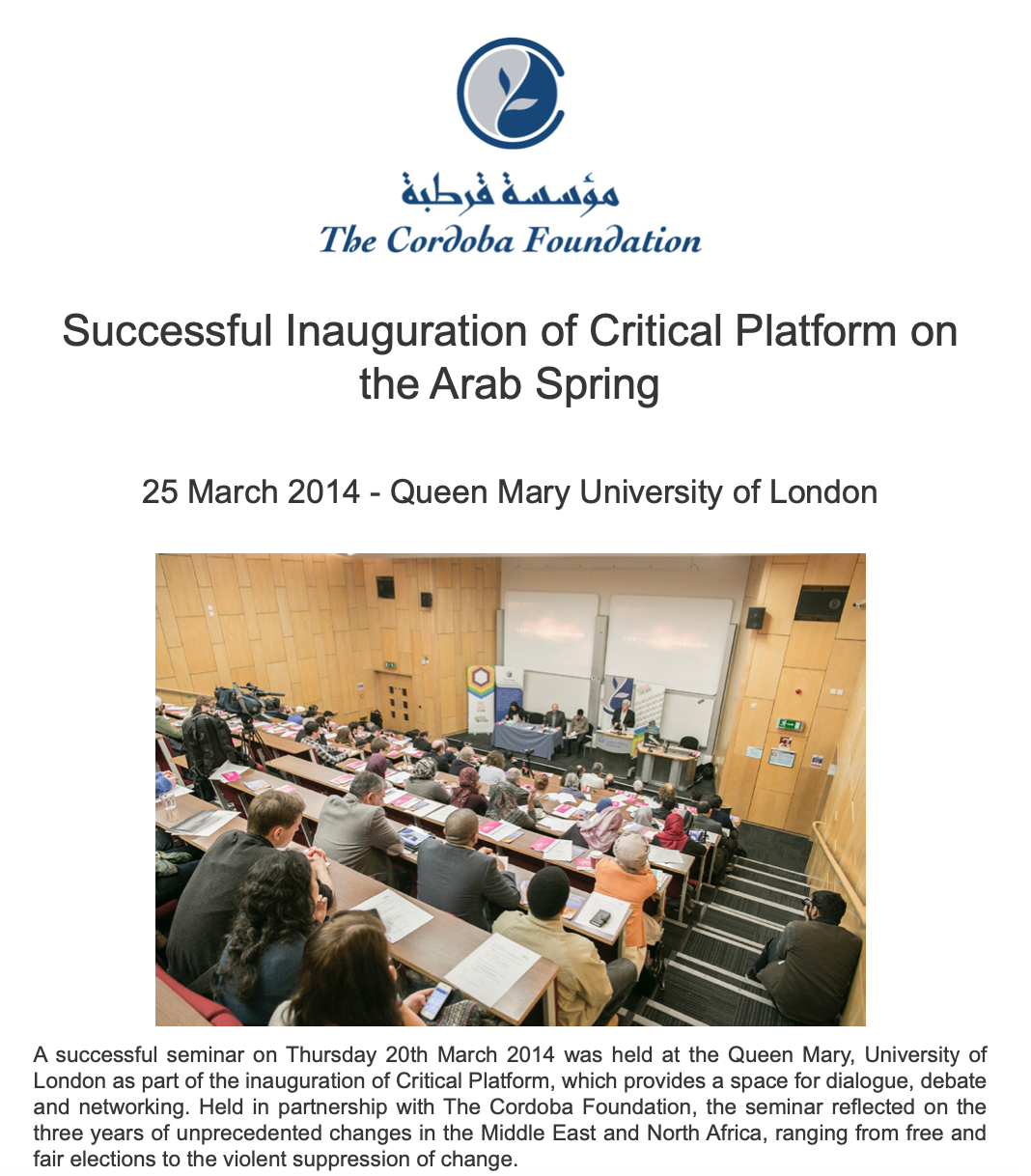
A successful seminar on Thursday 20th March 2014 was held at the Queen Mary, University of London as part of the inauguration of Critical Platform, which provides a space for dialogue, debate and networking. Held in partnership with The Cordoba Foundation, the seminar refected on the three years of unprecedented changes in the Middle East and North Africa, ranging from free and fair elections to the violent suppression of change.
Helping shed light on the topic, a distinguished panel comprising of Dr Maha Azzam, chair of Egyptians for Democracy UK; Oliver McTernan, Director of Forward Thinking, and Dr Anas Altikriti, CEO of The Cordoba Foundation addressed the topic from numerous angles and took questions from the foor.
TCF_Report_CP_ArabspringPlease click here for a copy of the event report (NB, size of the file is 2.5MB)
The above event, jointly hosted by The Cordoba Foundation and the Enough Coalition Against Islamophobia, took place on 11th February 2014 at the London Muslim Centre, London. It was part of the Cordoba Seminars series, which analysis issues and developments in the arena of research, dialogue and current affairs.
Moderated by William Barylo, Research Assistant at The Cordoba Foundation, the event was opened by welcoming remarks by Dilowar Khan, Executive Director of the London Muslim Centre (LMC), and Abdullah Faliq, Head of Research at The Cordoba Foundation. Khan explained how the LMC has been targeted by racists and extremists connected to the English Defence League who were trying to create tensions in the community. Faliq echoed the same and added that the recent attempt by the so-called Christian Patrols to protest outside the East London Mosque were trying to stoke-up religious tensions, namely between Christian and Muslims.
Following the introductions, Konrad Pedziwiatr, an Assistant Professor at the Tischner European University in Krakow, Poland delivered his presentation. Pedziwiatr holds a PhD in Social Sciences from the Katholieke Universiteit Leuven (Belgium), MA in European Studies from Exeter University, UK. and an MA in Sociology from the Jagiellonian University, Poland. He is a member of the American Sociological Association and the International Society for the Sociology of Religion. Konrad is also a Pierre et Marie Curie Research Fellow at the University of Bradford, UK. His research interests comprise sociology of migrations, religions, cultures, ethnicities and questions of identity and citizenship at a transnational level. He has published widely on various dimensions of Muslim presence in Europe and was featured as an expert in William Barylo’s documentary, “Polish Muslims: an Unexpected Meeting”.
Pedziwiatr started his presentation by presenting relevant concepts of sociological citizenship in relation to cultural diversity and religion. As some authors do not necessarily agree with the inclusion of religion as part of citizenship (Hobbes, Hollenbach), others find it helpful (Verba, Putnam, Weithman) to offer a so-called “good” life to society.
Some European Muslim thinkers (e.g. Tariq Ramadan) urge Muslims to participate in the social life of their societies, rending them as active citizens. This is a vision most young European Muslims agree with, which has backed-up by Pedziwiatr’s fieldwork, participant observation and through interviews, although a minority fall into what he calls “an uncompromising religiosity”.
Pedziwiatr stressed that Islamophobia is widespread even in areas with an extreme minority of Muslims like Poland (0.1% of the population). More paradoxically, people from these areas, according to statistics, tend to have a more negative image of migrants in general and Muslims in particular. Pedziwiatr calls this phenomenon “Platonic Islamophobia,” as people are afraid of Muslims, even if they have never met one in person. He regards that the Polish media as one of the most important factors to the spread of Islamophobia in this context, as they mainly relate sensational events, even if not linked to Poland or to international events, for example so-called Muslim Patrols in London. He drew a parallel with a similar situation in Hungary where nationalists protested against the Jewish community.
Pedziwiatr concluded his presentation saying that in spite of the climate of fear, suspicion and challenges faced by Muslims, key Muslim figures are active in the public sphere such as in the political scene. These Muslim elites can be a motivational factor to younger generations that could perhaps emerge in the future, and this trend may intensify in the near future.
The roundtable was attended by students, academics, policy-makers, media and activists from all faiths and none. The presentation was followed by a dynamic session of questions and answers. The audience was content to find a topic of common interest and an intelligible scientific analysis.
.jpg "KP_RDtable (15).jpg")
.jpg "KP_RDtable (14).jpg")
.jpg "KP_RDtable (8).jpg")
On Tuesday 1st October 2013, The Cordoba Foundation hosted a closed-door high-level roundtable on the crisis in Egypt. The roundtable brought together representatives from the High Commissions of several Southeast Asian countries, and expert political reporters and analysts. The aim of the roundtable was to discuss the current situation in Egypt and to explore the role that the international community, in particularly Southeast Asian countries, could play.
The roundtable opened with an update on the current political and social situation in Egypt and a briefing on the key events which led up to the current crisis. Starting from the 25th January 2011, a series of protests were held across Egypt which called for social justice and demanded the overthrow of the regime of Hosni Mubarak. The ‘Revolution of the 25 January’, as it came to be known, resulted in the formation of a civilian state which was later dissolved on 3rd July 2013 when the opposition, fronted by the military,overthrew President Mohamed Morsi. Most recently events have included: a court ruling to dissolve the Muslim Brotherhood as an NGO and banning it from carrying out any activity in Egypt (which includes the social services that the socio-political group provide: schools, hospital and charities), and the freezing of all Muslim Brotherhood assets. For further details about this, please click here
There has also been a clampdown on freedom of expression: the detaining of anyone calling for democracy which includes the detaining of at least 70 minors (Human Rights Watch); freedom of assembly: a series of attacks carried out by security forces on Muslim Brotherhood led protests which were held under the banner of the ‘Anti-Coup Alliance’in which over 6.000 people have been killed and over 15,000people have been injured; and freedom of press: 7 media outlets have been shut-down.Participants highlighted that the acute humanitarian conditions are indicative of the return of both a security state and an oppressive regime.
Participants in the roundtable applauded the role of The Cordoba Foundation in facilitating forums for such discussions, and pointed out that peace in Muslim countries would mean prosperity for the entire Muslim Ummah who, as a demographic, represent amajority in a number of Southeast Asian countries.
The representatives from High Commissions of the Southeast Asian countries expressed their hopes that the Egyptian military would carry out the road map that they proposed: which promised fair elections and a new and more inclusive government. However, they added that if the military failed to deliver on this then the international community would have the scope to change their stance. It was pointed out by participants that at this moment in time the military were not showing any goodwill signs to fulfilling their promised road map which is illustrated by not inviting the Muslim Brotherhood to join any ministry or the constitutional committee.
Participants expressed the was a need for key regional players, like Saudi Arabia, to change their political positions on Egypt in order to ensure a more unified international approach. It was mentioned that from the outset Saudi Arabia and other Gulf states miscalculated and antagonized the Muslim Brotherhood. Participants put this down to a number of reasons including: the superficial reading of the ‘Islamist’ label which generalised political Islam and the threat that democracy posed to the Gulf monarchs who, because they feared their own demise, took an active role in reversing the progress of the elected Muslim Brotherhood in Egypt. It was argued that such regional players may reconsider their viewpoints if they were made aware of the real situation ion the ground in Egypt andobjections to their stance on Egypt by the public and key religious leaders. However, by taking local politics into consideration, one can question the impetus with which to work to muster people; Saudi Arabia, like many Gulf states, have large repression campaigns in which many people have been imprisoned because of their freedom of expression on social media. For more information, please click here
 Participants of the roundtable acknowledged that there has been a muted response by the international community, which could be partly down to turn of events in Egypt occurring at a time when many governments had adjourned for their summer recesses. In addition, participants also expressed the importance of the international community to agree on and address the following issues:
– Failures in human rights and the need for investigations into the atrocities committed
– The freedom to protest
– The safety of president Mohamed Morsi, protesters and political prisoners
– Release of imprisoned academics
– Media control
– The freezing of the assets of the Muslim Brotherhood as a political group, and their freedom to campaign
– Promise of fair and free elections
– The fear of the revolution of the poor because of the state of the economy
On Wednesday 23rd and Thursday 24th October 2013, the University of Wroclaw in Poland hosted a public conference, titled “Exclusive Citizenship and Contemporary Theories of Transnational Justice,
Multiculturalism, Neutrality, Contract, Free Speech, Neo-racism and Deliberation”.
The conference was organised jointly with the University of Tromsø, Norway. The aim of the conference was together authors approaching the problem of transnational justice on local, state, regional and global perspectives, using a range of approaches including socio-political, cultural and religious.
This is a summary of the proceedings of that timely conference.
The conference was attended by William Barylo, Research Assistant at The Cordoba Foundation
TCF_Report_Wroclaw23102013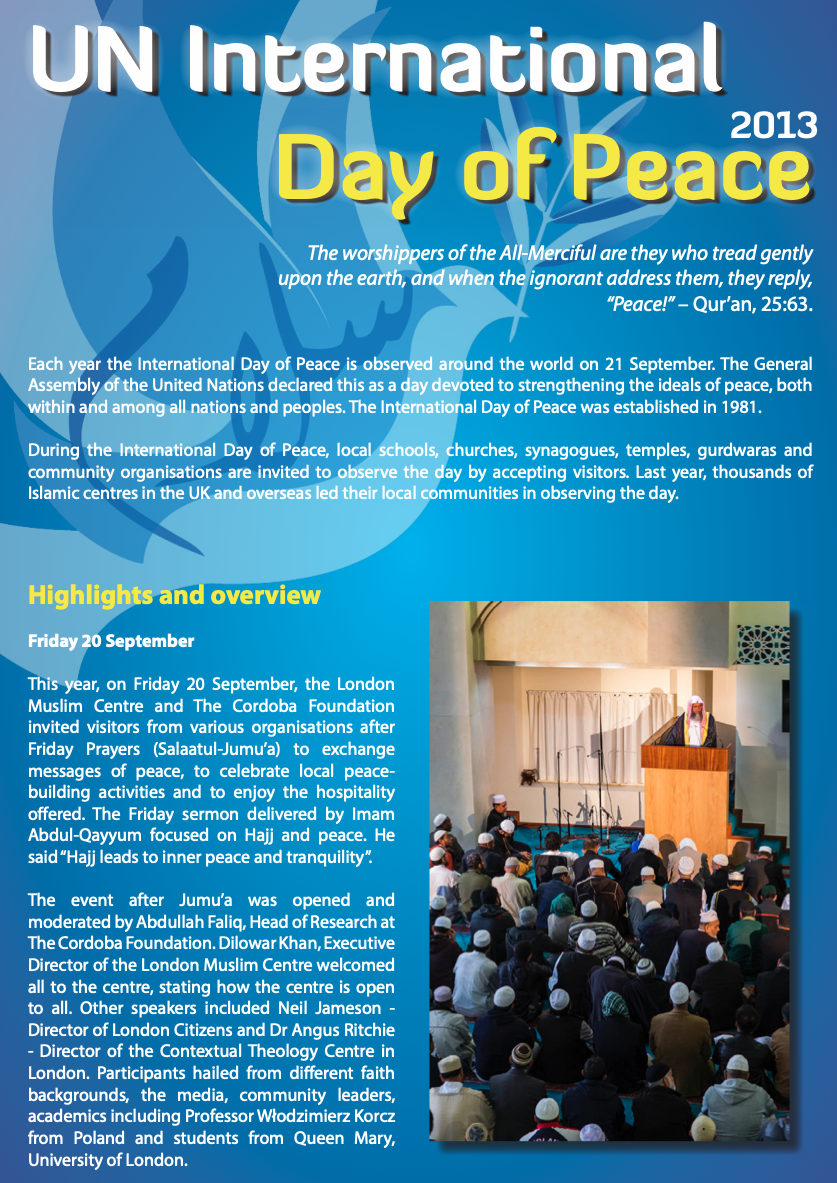
Each year the International Day of Peace is observed around the world on 21 September. The General Assembly of the United Nations declared this as a day devoted to strengthening the ideals of peace, both within and among all nations and peoples. The International Day of Peace was established in 1981.
During the International Day of Peace, local schools, churches, synagogues, temples, gurdwaras and community organisations are invited to observe the day by accepting visitors. Last year, thousands of Islamic centres in the UK and overseas led their local communities in observing the day.
This year, on Friday 20 September, the London Muslim Centre and The Cordoba Foundation invited visitors from various organisations after Friday Prayers (Salaatul-Jumu’a) to exchange messages of peace, to celebrate local peace-building activities and to enjoy the hospitality offered.
DayOfPeace_TCF
Announcing the latest edition of, the MENA Report, providing insights and analysis of events and developments in the Middle East and North Africa (MENA).
This edition provides an insight into the Saudi state and its Salafi trends\
tcf_mena_sept_final1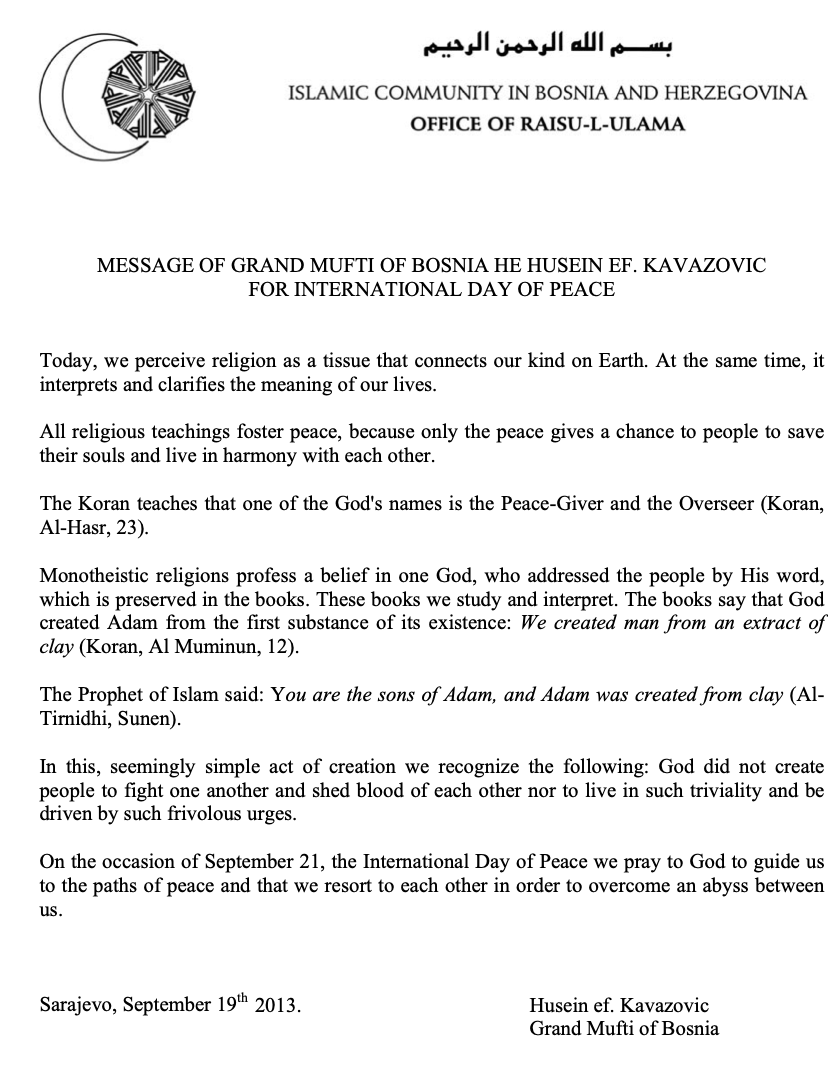
The Cordoba Foundation is pleased to share a message from the Grand Mufti of Bosnia on the occasion of the International Day of Peace.
The message reminds us of the unity of human beings and the need to preserve this.
international