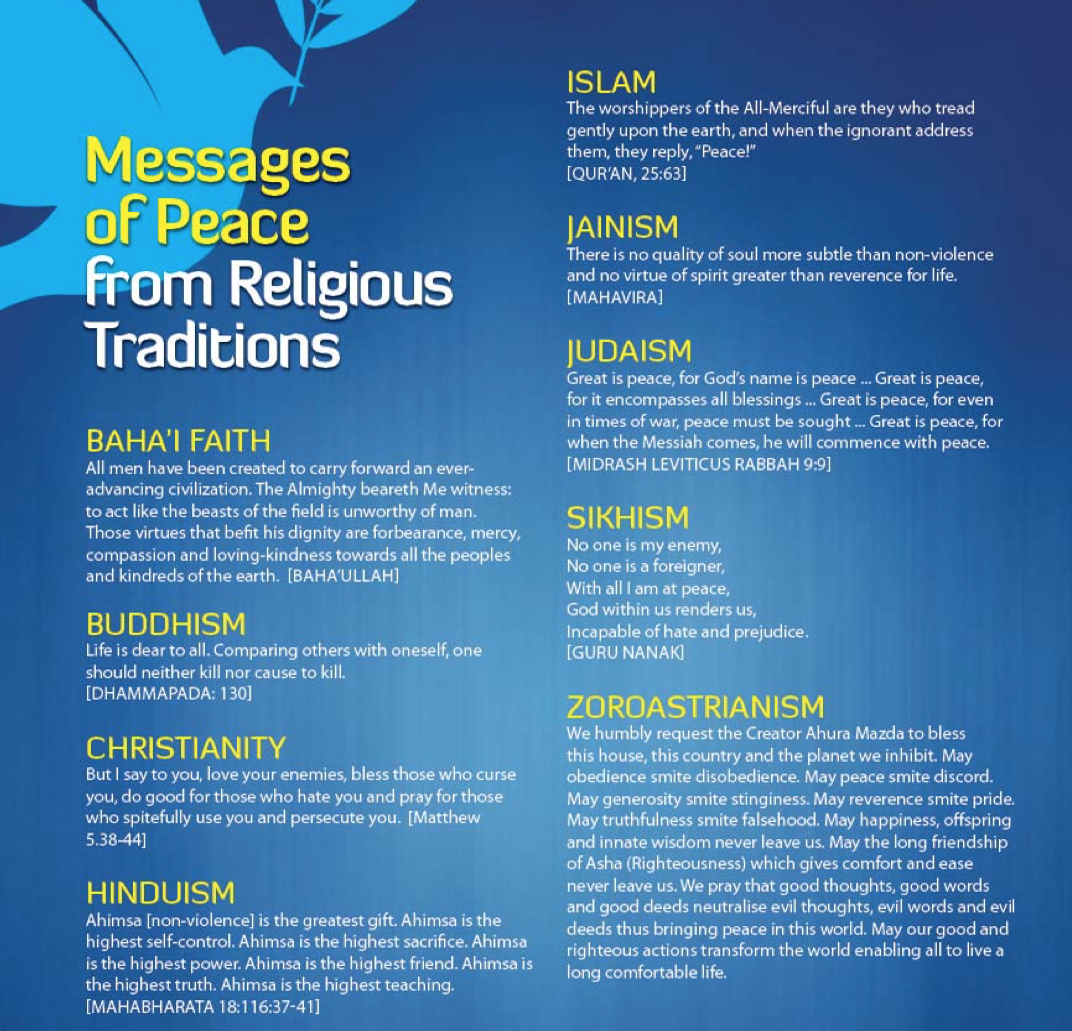
Messages of Peace from Different Religious Traditions
To commemorate the International Day of Peace, The Cordoba Foundation shares messages of peace from different religious traditions
Messages_of_peace

To commemorate the International Day of Peace, The Cordoba Foundation shares messages of peace from different religious traditions
Messages_of_peace
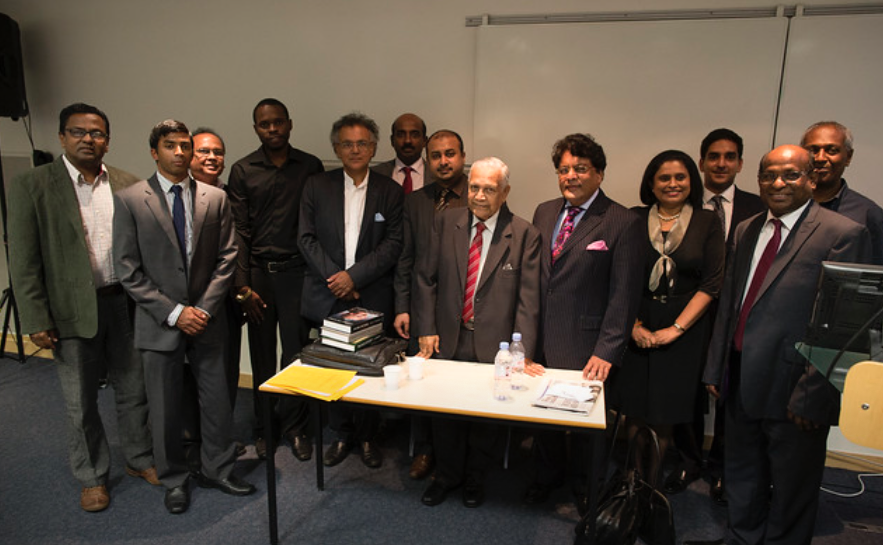
In a thought-provoking lecture Sri Lanka’s internationally-renowned jurist, academic and author, Prof. Christie Weeramantry warned that if the 21st continued in its destructive and bungling ways there would be no 22nd century
Describing the modern day as the most rapacious in history Prof. Weeramantry blamed the power of money, the power of science and the military for pillaging the earth.
He said that thousands of years-old religious teachings that called on rulers and the ruled to protect and preserve the environment and safeguard natural resources are being neglected or rejected, breaking the age-old nexus that existed between religion and human conduct.
A former Judge of the International Court of Justice in the Hague, a professor of law at Monash University in Australia and a justice of the Supreme Court of Sri Lanka, Prof. Weeramantry was speaking to an audience of barristers, solicitors, law students and others in London last week on global religious wisdom as an enrichment of international law and an aid to the solution of current conflicts.The lecture was organised by the Association of Sri Lankan Lawyers in the UK and The Cordoba Foundation.
Referring to the world’s major religions- Hinduism, Buddhism, Islam, Christianity and Judaism- he said that the wisdom expressed by these religions and the religious leaders 3000-4000 years ago had anticipated today’s international law.
Whereas the wisdom of those religions should have formed the foundations of international law and the conduct of countries and rulers, those wise words are in reality ignored or relegated to the background despite the lip service paid to religion.
Prof Weeramantry also debunked the belief among some in the western world that international law was essentially a creation of the west. Such a conclusion, he said, is untenable because several thousand years earlier all major religions had reflected on and pronounced on a whole gamut of human activities.
Citing various religious teachings Prof. Weeramantry showed modern international law had already been anticipated by these religions which originated in Asia.
Drawing on his experience as a teacher and an international judge Prof. Weeramantry lamented that the teaching of law today remained an arid discipline and appealed to the legal profession to help rebuild the bridge between religion and international law.
A recent post in the Colombo Telegraph by the ‘PM of the TGTE’ expressed solidarity with the Muslim community whilst “extending our fullest support to the Muslim people, we also extend our solidarity to the Muslim community, as a community whose mother tongue is also Tamil, asking them to join the Tamils in their struggle to build a secure future for all in the Tamil state”. The article was written on the back of rising incidents of attack against the Muslim community by extreme Buddhist groups.
I not only found this article laughable but highly delusional in the assumptions that the Muslim community would entertain any notion of an alliance with the TGTE, whose singular premise has been to extend the LTTE mantra and campaign on a separate Tamil state. Making this statement, the TGTE was not necessarily ‘concerned’ about the Muslim community per se, but it was aimed at showing the ‘intolerance’ of Sinhala Buddhist chauvinism. At quite a crucial time for Sri Lanka, during the anniversaries of the Black July pogroms 30 years ago, the article aims to draw parallels with then and now and to show that nothing has changed. Yet interestingly it seems to have taken the TGTE 4 years since the end of the conflict (and the occasions of these incidents) to publicly reach out to the Muslim community
To read more, please click here
If there is one thing that consistently defines this era that we are living in, it is the role of the media in how it not only shapes our politics, ideology and world view but also how it seeks to manipulate issues and narratives for its own goals. We all remember the concerted media campaign that preceded the invasion of Iraq in 2003. The political establishment and a large proportion of the general public were convinced that Iraq had a viable nuclear and chemical arsenal. The orchestrated media campaign by traditionally respectable media outlets like the BBC and the Sky Middle Eastern coverage tended to stoke-up fear in the hearts of the population. Some politicians genuinely believed that unless there was a pre-emptive attackon Saddam Hussain, our civilisation and our way of ’’life’’ were in mortal danger. We all know too well the consequences of the invasion. Likewise the Leveson Inquiry in the UK has called to question media ethics.
With the crises and incidents unfolding in Egypt, truth is once again the main victim — in the absence of real democratic institutions and an inherently-corrupt and unprofessional media. The loss of life over the past week — whilst utterly shocking — veers into insignificance compared to the web of lies that have been spun around to justify these killings by the government officials and those who back the military operation. What is even worse is the reception these lies seem to be getting in the West as figures are misquoted and justifications reiterated.
The flow of information from the official sources should not be taken at face value. Western leniency with the coup leaders in Egypt encouraged the army and security services to massacre hundreds of demonstrators in the streets of Cairo. These crimes were preceded by an unbelievable array of propaganda willingly reiterated by American and British officials in their briefings in the past few weeks. Take for example the American official who reaffirmed the outrageous Egyptian claim that 30 million people took to the streets of Cairo on the eve of June 30th to call for a military intervention and end Morsi’s rule.
The influence of the mass media on ordinary people in the Middle East is widely acknowledged. In the Egyptian case, money from the UAE and Saudi Arabia has fuelled a frenzied media attack on the nascent democratic institutions in Egypt to the extent that ordinary citizens were willing to sacrifice theirvote and political freedoms in order to end their miserable economic and social situation, so they were led to believe. Paradoxically the Saudi and the Arab Gulf states concentrated in their media campaign on the issue of the Western conspiracy with the Muslim Brotherhood to destabilise Egypt and sell its assets to foreign investors. They played on the ordinary people’s sentiments and religious sensitivities. They even claimed that the new democratic government in Egypt is in cahoots with the West and the Israelis.
Unfortunately most of the information about opposition movements in the Arab and Muslim world available to Western circles was amassed from security services and academic institutions linked to it. It was only in the last 30 years when large number of political activists and academics took refuge in the West that we saw certain changes in attitude towards a relative understanding of political Islam. At the same time the exposure to Western political theory and practice had a huge influence on the politics of the proponents of contemporary political Islam. The same strategy is followed by monarchic regimes and sheikhdoms in the Arab Gulf region. Although these regimes are considered pro-West, they support and give sustenance to religious clergy faithful to the regimes to demonise all what the Western democracies stand for. In the case of Egypt, we have witnessed how traditionally apoliticaland rejectionist trends like the Salafists have been used to defend and justify the military coup. Similarly, the head of Al-Azhar University, the most prestigious religious institution in the Muslim world, has not been spared. Here again, Western political, cultural and ethical ideals are the target. A barrier is erected between their people and international concepts such as democracy and free will.
The Egyptian military and the Gulf regimes used religious and cultural cleavages with the West to end the infant democratic experience. Unfortunately, they succeeded with an undeniable tacit approval by democratic governments in the West. This is evident of Western ancient religious sensitivities being undoubtedly intertwined with their contemporary politics.
Dr Fareed Sabri is head of the Middle East and North Africa Programme for The Cordoba Foundation

I expect people reading this to be quite busy and so I will forego the usual essay style and use a point format. As a preamble, there are two arguments I will not make. I will not argue that the President’s first year in office was mistake-free. There were many and the President alluded to some during his most recent speech before the coup. The second argument I will not make is that the coup has no popular support. Without a doubt, there is significant resentment among a considerable portion of the Egyptian population towards the President. Nevertheless, neither of those considerations – mistakes and alienating part of the electorate – constitutes reasonable grounds (if ever such an adjective could be used) for a military coup.
Coup apologists are using a number of accusations to justify the coup.
a. Egyptians lack the “basic mental ingredients” for democracy
b. President Morsy was not inclusive during his year in government and was unable to unite the country. But for the military coup, the country would have descended into chaos and civil war.
c. The President, and the Muslim Brotherhood, were intent on building an “illiberal” democracy, one where there was voting, but were human rights including freedom of speech and express as well as women rights are limited.
d. The economy was imploding due to the poor management of the country and the Army had to intervene.
e. This was not a coup. This was a popular uprising and the army merely supported the people a la February 11, 2011.
I will not distinguish (a) above with a response. The remainder of those arguments, even if there is some truth to them, is entirely without merit as a justification for a military coup that derails the democratic transition of the country.
To read more, please download the paper from here

The Cordoba Foundation and the Embassy of the Republic of Poland in London launched a new film about Islam in Poland, directed by William Barylo. Hosted by Witold Sobków, the Ambassador of the  Republic of Poland in London, the screening of the film and Iftaar (breaking of the fast) took place at the Polish Embassy in London on Thursday 18th July.
The film, “Polish Muslims: An Unexpected Meeting”, was directed and produced by William Baryło, a doctoral candidate at the EHESS, Paris and Research Assistant at The Cordoba Foundation.
The film gives insights to the sheer diversity of the Muslim communities in Poland and provides a glimpse of the relationship between Muslims and the whole Polish society. More than describing the centuries-old Muslim legacy in Poland and presenting the current challenges for the Polish society, ‘Polish Muslims’ explores the building of bridges in a multi-cultural society.
In attendance were leading figures from Muslim, Jewish and multi-faith organisations, charities, research institutions as well as community activists and youth.
 The event was moderated by by Dr Anas Altikriti, CEO of The Cordoba Foundation and opening remarks from His Excellency, Mr Witold Sobków, Ambassador of the Republic of Poland in London.
Dr. Altikriti remarked that “it is more than a happy coincidence that the name of the Ambassador coincides with Prince Witold, who welcomed in the 14th century the very first waves of Muslim Tatars to Poland.”
His Excellency, the Ambassador, studied Islamic Studies and Arabic Language in SOAS, welcomed the audience with a respectful “As-Salaam Alaykum”. He underlined the importance of knowledge to “fight prejudice, ignorance and stereotypes.”
Describing himself as an advocate of “the peaceful coexistence of cultures”, he asserted that Islam is a “peaceful religion, not a threat”, and highlighted its key values of “justice, compassion and solidarity.” The ambassador stressed the need for a society that is respectful of cultures, and urged all to “do our best to fight Islamophobia”, and that “the corrosive effects of Islamophobia should be recognised as unacceptable and not tolerated.”
The Ambassador extended its words of appreciation to The Cordoba Foundation “for their initiative, innovative approach and the clear vision of the work they have been carrying out since 2005”. He further commented: “The objectives of the Foundation are relevant in the times we have come to live and I hope that by the means of systematic and strategic steps we can ensure the progress of a peaceful and respectful coexistence of cultures, ideas and people.”
About the film, the ambassador admitted that “the lives and experiences of the Muslims in Poland is in many ways an unknown territory to many people” and thus congratulated the film director, William Barylo, for “all his efforts in bringing this part of Poland closer to us.”
His Excellency, Mr Sobków described the film as “fantastic”. Whilst there was a lot everyone learned from the film, he pointed out the film’s objectivity, which showed both the positive side and the challenges facing the Muslim communities in Poland.
Providing an overview of Poland’s cultural wealth and complexity, the film raises interesting and pertinent issues for discussion and debate. Precisions have been given especially on the general open-mindedness of the Polish society and government towards minorities, the activism of young Polish Muslims and the different Muslim representative organisations.
Rabbi Herschel Gluck, founder of the Jewish-Muslim Forum, said “this is an important perspective about a community which many are unaware of. It’s very important as an European that there is a thriving Muslim community in Poland which is respected and which is very engaged with Polish life. It’s actually an integrant part of the Polish narrative.”
Alicja Kaczmarek, head of the Polish Expats Association, commented: “The film was very beautiful and very interesting. A real eye-opener, proving communities can actually exist together. There is something we can learn whatever part of the world we are from. It generated an interesting conversation after.”
Catriona Robertson, convenor of the London Faith Boroughs Network (LFBN) and An executive member of the European Network on Religion and Belief (ENORB), said “I loved the film, because it is very particular. It doesn’t fall into the trap of generalisations.”
Dr AbdoolKarim Vakil, lecturer in Kings College London found “a wonderful film for opening up a window in a country and a context I don’t really know much about. I hope there will be a sequel of this movie.”
The Cordoba Foundation hopes with optimism that this film, questioning perceptions of cultural and religious differences, could foster a more lucid look onto the world’s 21st century multi-cultural society. The Cordoba Foundation is pleased that this event signals, hopefully, the beginning of future collaboration with the Embassy of the Republic of Poland.
 The organisers thank the Polish Embassy in London for hosting the screening of this documentary at the embassy during the Muslim holy month of Ramadan. The event ended with a call to prayer and breaking of the fast (Iftaar), with a delicious Polish buffet.
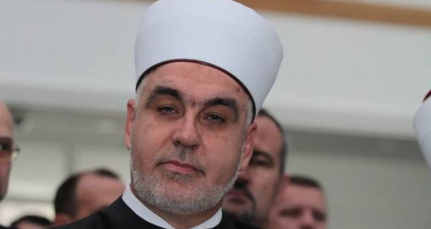
As thousands converge in Potocari today for the funeral prayers of over 400 bodies and the 18th anniversary of the Srebrenica genocide, we are once again reminded of the lengths that man could potentially go to when immersed in a state of fear, hatred and division
The Memorial Day puts to rest any naivety that the lessons of the past have not only been learned, but well and truly headed. Not only are human beings chronically capable of committing the most repugnant of acts against fellow human beings, regardless of the advancement of time, the catalysts for these crimes are invariably similar whatever the different and unique circumstances of each.
The Cordoba Foundation has been working tirelessly to raise awareness of the threat man poses against his fellow man, should particular conditions become established on the ground. Whether Srebrenica, Auswitz, Rwanda, Gaza, Kashmir, Myanmar or Somalia, and whether in the last century, this or the one coming, injustice establishes fear which breads suspicion and ultimately hatred. From there, the move on to violence is neither a difficult nor inconceivable step to undertake. Our objective is to work in common collaboration to remove the very initial elements on that tragic path, and to counter the root causes for clashes based on false and misguided understanding and implementation of the concepts of ‘self’ and ‘the other’.
The Srebrenica Memorial Day provides a timely reminder to us all of the challenges that can only be met in a sense of togetherness and community.
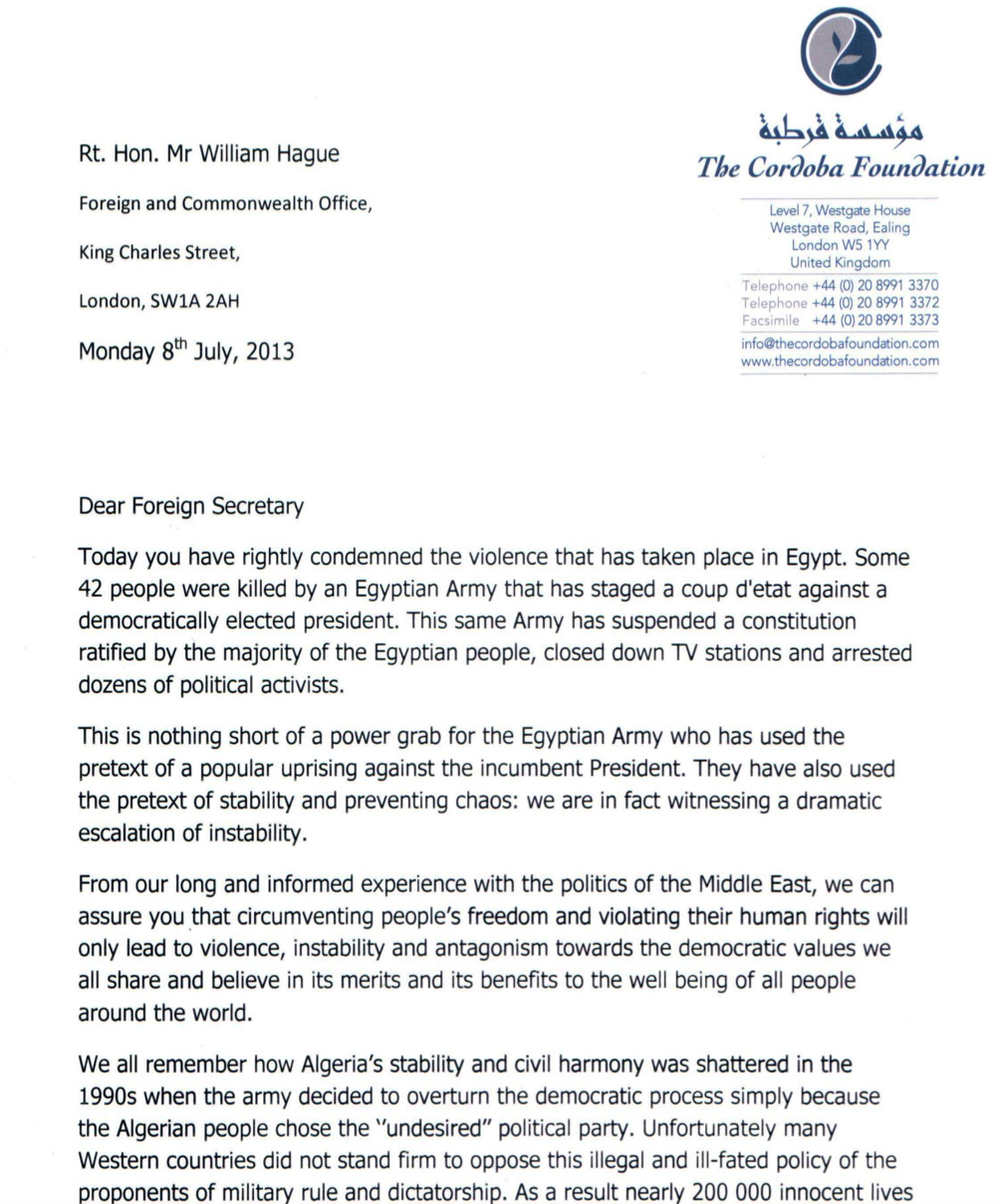
The Cordoba Foundation (TCF) has written to the US Secretary of State and the UK Foreign Secretary expressing concern about the events in Egypt
Dr Anas Altikriti, the CEO of TCF expressed concern that cirumventing people’s freedom and violating their human rights will only lead to violence, instability and antagonism towards the democratic values, we all share and aspire for all over the world.
THe Cordoba Foundation urges a moral and ethically weighted position from both the UK and the US in dealing with the situation in Egypt
To read the letter to the UK Foreign Secretary, please click here
letter_to_william_hague
To read th letter to the US Secretary of State, please click here