
Event Report: Launch of Cordoba Papers – A Call to Action for Muslim Civil Society in Britain
On Wednesday 26th June at the Osmani Centre, London, The Cordoba Foundation launched the latest in a series of the Cordoba Papers, titled “Meet the Challenge, Make the Change – A Call to Action for Muslim Civil Society in Britain”.
 Authored by Dr. Muhammad Abdul Bari – a leading figure in the Muslim community – the paper attempts a critical look at the Muslim community, particularly in Britain and the role and performance of Islamic organisations.
Providing a good mapping exercise, the paper charts a way forward through a bold and clear presentation but also raises interesting and pertinent issues for discussion and debate.
The publication was reviewed by writer and researcher, Dr Jamil Sherif and moderated by Dr Anas Altikriti, CEO of The Cordoba Foundation. In attendance were leading figures from Muslim organisations, charities, research institutions as well as community activists and youth. Dr Altikriti said “we welcome the open discussion and debate that took place during the launch of this timely publication, which is lacking in the community.”
Other discussants, including Dr Zahid Parvez – Rector of the Markfield Institute of Higher Education based at the Islamic Foundation in Leicestershire, pointed out the need for British Muslims to better engage with civil society on general interest issues. He said, “whilst we acknowledge a leadership-deficit in the Muslim community, new and credible leadership will emerge automatically in different spheres of our society.”
Lotifa Begum, Development Education Coordinator for Islamic Relief, commended Dr Abdul Bari for penning this paper and initiating discussion on this very important topic amongst stakeholders in the community”. Tarek el Diwany, consultant and analyst in the field of Islamic finance for Zest Advisory LLP, and author of The Problem With Interest, remarked that “we need to do away our fascination with labels and organisational bureaucracy and focus more on making real contribution to society, in the fields of media, medicine, finance and so on.”
 Responding to questions and points addressed to Dr Abdul Bari, he stressed that “overcoming cultural and religious differences is a priority to building a better future together with different stakeholders, as demonstrated in the life of Prophet Muhammad since the very beginning of the Revelation.”
The Cordoba Foundation hopes that Dr Abdul Bari’s paper will inspire and probe those currently at key positions in the Muslim community to reflect on some of the issue and challenges highlighted but also to look forward to making the change for a better Muslim civil society in Britain.
The full publication can be downloaded from here


Jubilant Crowds May Yet Come to Regret End of Brotherhood Government
Only 29 months ago, Egyptians were united in celebrating the removal of Mubarak’s 30-year rule and the triumph of what seemed a glorious revolution that had inspired many around the world. This week, the Egyptian people, back on the streets in their many millions, were deeply divided almost down the middle over the question of legitimacy.
Mohammed Morsi, the first democratically elected president in the history of Egypt, stated in his last official speech that he would defend ‘legitimacy’ with his life. To his supporters and most neutral observers, he clearly meant defending the civil democratic elections, reflecting the will of the people in the face of an overriding military intervention. Without this the entire process would be defunct. To his opponents, it was a thinly-veiled threat and ultimatum threatening civil conflict, for which he lost all claim to his privileges to office.
To read more, please click here
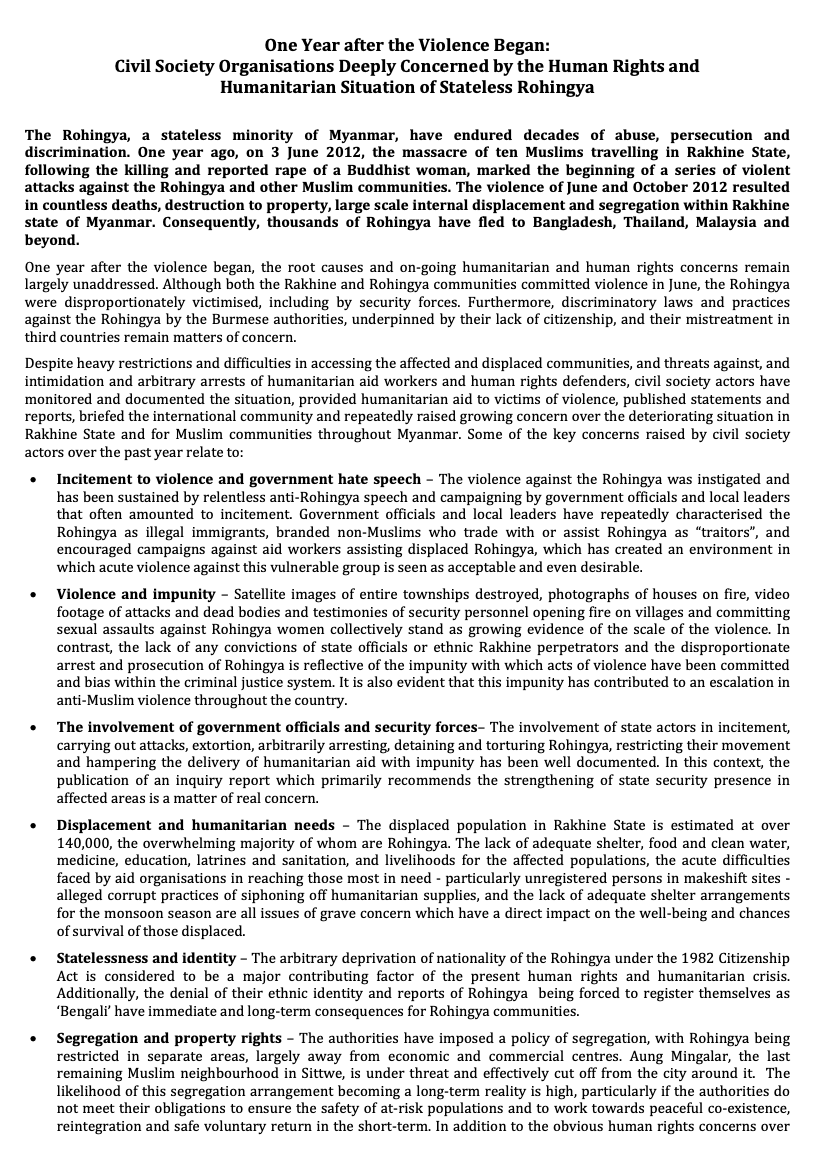
Seventy Six Civil Society Organisations Call for Greater Protection of Rohingya
Today, the Equal Rights Trust, The Cordoba Foundation and 75 other civil society organisations issued a joint statement calling for an end to on-going human rights and humanitarian abuses against the stateless Rohingya in Rakhine state of Myanmar. The statement, which is simultaneously being issued by organisations on five continents and sent to the President of Myanmar and Myanmar embassies around the world, is an expression of global civil society solidarity regarding human rights protection of the Rohingya.
The Rohingya, a stateless minority of Myanmar, have endured decades of abuse, persecution and discrimination. One year ago, on 3 June 2012, the massacre of ten Muslims travelling in Rakhine State, following the killing and reported rape of a Buddhist woman, marked the beginning of a series of violent attacks against the Rohingya and other Muslim communities. The violence of June and October 2012 resulted in deaths, destruction to property, large scale internal displacement and segregation within Rakhine state of Myanmar. While up to 800 deaths resulting from the violence have been documented, it is believed that the actual number is in the thousands. The subsequent mass exodus has led to a rise of the numbers of Rohingya refugees fleeing to Bangladesh, Thailand, Malaysia and beyond.
One year after the violence began, its root causes, as well as on-going humanitarian and human rights concerns, remain largely unaddressed. Although both the Rakhine and Rohingya communities committed violence in June, the Rohingya were disproportionately victimised, including by security forces. Furthermore, discriminatory laws and practices against the Rohingya by the Burmese authorities, underpinned by their lack of citizenship, and their mistreatment in third countries, remain matters of concern.
The Joint Statement alerts the international community to several trends observed by civil society organisations over the past year, with regard to the crimes against humanity perpetrated by the Myanmar authorities; the lack of protection for Rohingya refugees and asylum seekers; the violence against the Rohingya and the impunity of perpetrators; the incitement to violence and government hate speech; the involvement of government officials and security forces; the displacement of the Rohingya; their urgent humanitarian needs; their statelessness; the segregation of the Rohingya and their property rights; the discriminatory restrictions on their family life and freedom of movement. The Joint Statement makes recommendations to the governments of Myanmar and refugee recipient countries and to the international community at large.
civilSri Lanka: The Uncertain Future for IDPs
In a previous piece for Fair Observer, I wrote about the plight of internally displaced persons (IDPs) who were victims of the Sri Lankan conflict at the hands of the LTTE, and who still remain without much hope of any viable solution today.
These victims, who have languished in camps for the last 23 years, have barely elicited a response except at election time when they become pawns of politicians. Recently, the politicisation and the ethnicisation of this agenda have pitted a Muslim politician against a Tamil religious leader in terms of who gets priority for resettlement — and effectively the bigger share of the resettlement pie. This development does not bode well for relations between the two communities
To read more, please click here

Survey- We Want To Hear From You
As part of our quest to improve our products and services, please participate in an anonymous online survey.
Please click here to participate
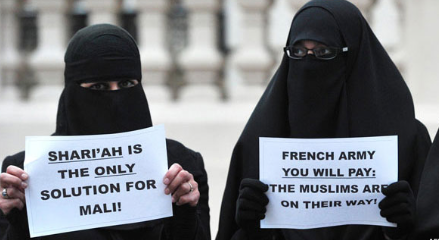
Press Release: Conflating Islamophobia with ‘Islamic extremism’ breeds misunderstanding
The Cordoba Foundation (TCF) rejects accusations made by Andrew Gilligan against our organisation in the Telegraph on 1 June 2013. Neither the TCF nor its partners recognise the picture painted by Mr Gilligan.
We have been accused as a ‘front organisation’ for the Muslim Brotherhood. Mr Gilligan tells his readers that this allegation was made by the Prime Minister when he was Leader of the Opposition in 2008, a time when hard-right ideologues such as the Policy Exchange (a think tank who was exposed for forging evidence in its report on ‘Islamism’ in 2007) would advise the Tories on its dealings with Muslims. We wrote to David Cameron in 2008 asking for him to substantiate his accusation. Other than a polite acknowledgement, nothing was forthcoming.
We are not surprised by Mr Gilligan’s latest missive against our organisation. The article containing his accusation against us is exactly the kind of cover that far-right extremists need to mask their campaign of hate since the horrific murder of Drummer Lee Rigby on 23 May. While mosques and British Muslims have been attacked and abused, Mr Gilligan has deployed Stalinist double-speak to play down these incidences. Mr Gilligan plays down these incidences even though Drummer Lee Rigby’s family and regiment has been moved to caution against reprisal attacks, in addition to showing their gratitude for the massive show of support given to the family by the Great British Public.
Just as the rest of the British Muslim community, we too condemn the murder of Drummer Lee Rigby. There is no cause that should justify his killing. It is a real shame that Mr Gilligan has deployed these underhand tactics to further his own divisive agenda. As before, we are in no doubt that the far-right will use Mr Gilligan’s words for their own messages of hate. We, on the other hand, will continue to to promote dialogue and understanding between cultures and civilisations, as well as fostering discussion with our collective efforts to stop this violence ever happening again.
TCF works to promote dialogue and understanding between cultures and civilisations as per its mission statement. Seeking to help resolve conflicts and tensions, TCF has been working (directly and through partner organisations) in Myanmar, Sri Lanka, Middle East and North Africa, Bosnia, Sudan, amongst other places. Dr Anas Altikriti, CEO of the foundation, helped successfully negotiate the release of eleven hostages to date, including Western Christian peacemakers taken hostage in Iraq in 2005.
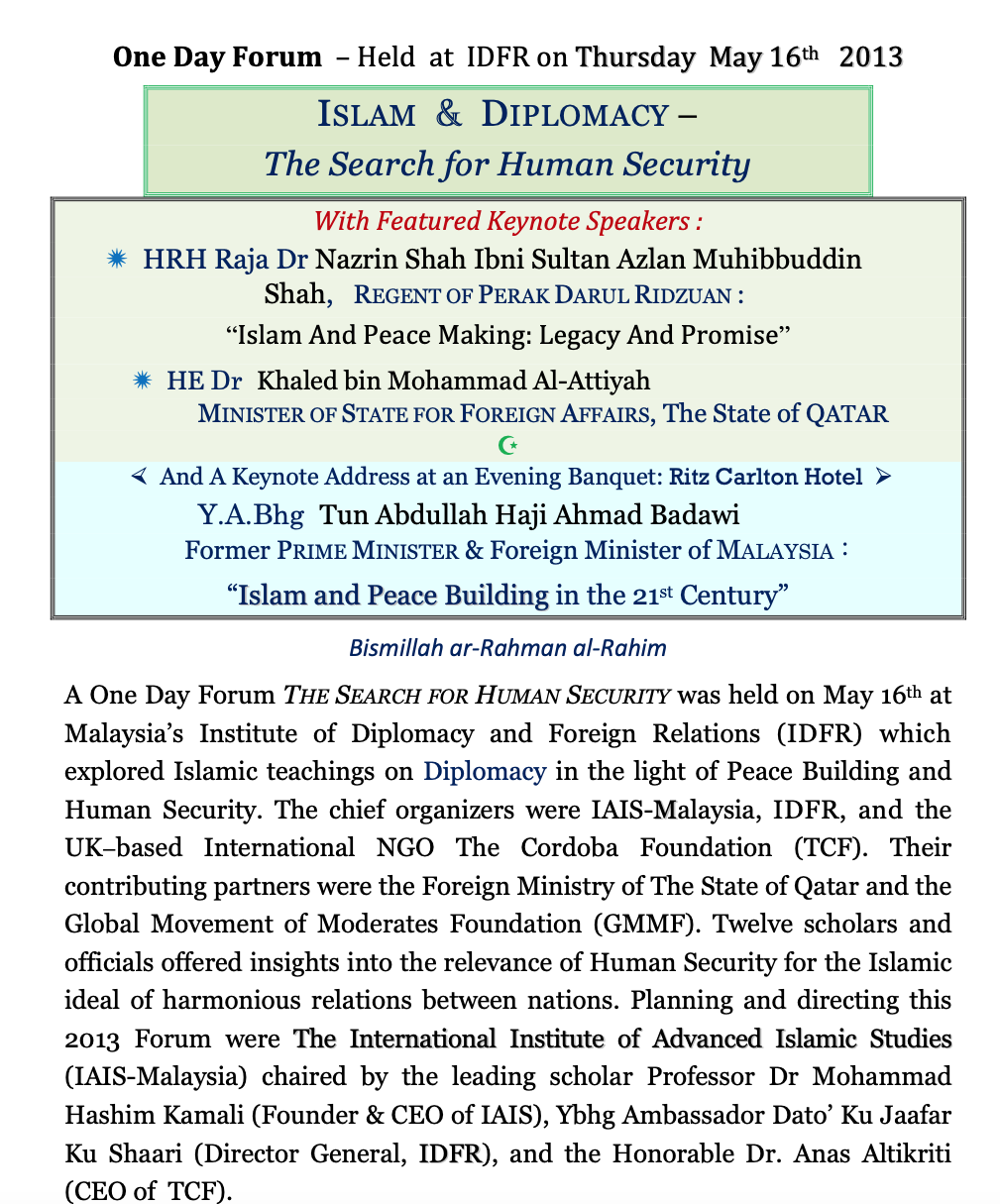
Event Report: Islam & Democracy – The Search for Human Security
 A One Day Forum THE SEARCH FOR HUMAN SECURITY was held on May 16th at Malaysia’s Institute of Diplomacy and Foreign Relations (IDFR) which explored Islamic teachings on Diplomacy in the light of Peace Building and Human Security. The chief organizers were International Institute of Advanced Islamic Studies (IAIS) Malaysia, IDFR, and The Cordoba Foundation (TCF). Their contributing partners were the Foreign Ministry of The State of Qatar and the Global Movement of Moderates Foundation (GMMF). Twelve scholars and officials offered insights into the relevance of Human Security for the Islamic ideal of harmonious relations between nations.
Outstanding highlight of the Forum was the morning Keynote address “Islam And Peace Making: Legacy And Promise” delivered by HRH Raja Dr Nazrin Shah Ibni Sultan Azlan Muhibbuddin Shah – Regent of Perak Darul Ridzuan, as well as the Royal Patron of IDFR. HRH gave an exemplary comprehensive overview of the current conditions of Muslim nations regarding human security. HRH stated that many Muslim nations are gravely lacking in its basic aspects, since “the comprehensive wellbeing of the people in a number of Muslim-majority countries leaves much to be desired.” Shortcomings include poverty, income inequality, poor educational and health care opportunities, political repression, and violent conflict. He pointed especially to the destabilizing effects of sectarian rivalry and tribal animosities which plague large areas of the Muslim world. HRH provided valuable insights into how our understanding of security should transcend the nation-state security paradigm, by adopting human and social requirements for developmental wellbeing and flourishing in harmony with Islamic teaching
 In the evening of May 16th a large Banquet was held at the Ritz Carleton Hotel in KL hosted by the Embassy of The State of Qatar, where Y.A.Bhg Tun Abdullah Haji Ahmad Badawi (Former Prime Minister of Malaysia & Patron of IAIS) gave his Keynote speech on ‘Islam and Peace Building in the 21st Century’. HE Khaled Al-Attiyah was in attendance along with HE Dr Hassan Al-Muhannadi (Director of The Diplomatic Institute, The State of Qatar) and many other dignitaries. In his remarks Tun Abdallah Badawi spoke of the “Muslim dilemma” which hinders Islamic nations from contributing effectively to Peace Building and promoting effective human security. He cautioned those present not to be complacent about conditions prevailing in Muslim societies, and to creatively re-think the need for fresh approaches to security and peace.
This SEARCH FOR HUMAN SECURITY Forum reflects expanded engagement with contemporary issues of Islamic peace and security by the two institutes IAIS and IDFR, who held their first conference in October 2011 on ISLAMIC PERSPECTIVES ON PEACE AND SECURITY. These two Forums highlight the close link between security and peace, for the word “Islam” signifies both closely related principles.
This 2013 Forum was intended to energize efforts by Islamic governments, Muslim civic organizations, and international NGOs to devote more resources to peace building efforts, and to actively pursue shared efforts at reconciliation and humanitarian needs.
press_release
For more details of the forum, please click here



News Release: Peace and Security Forum 2013
A one-day Forum on May 16th exploring Islamic teachings on Diplomacy in the light of global Peace & Security will be convened by IAIS-Malaysia with Malaysia’s INSTITUTE OF DIPLOMACY AND FOREIGN RELATIONS (IDFR) and THE CORDOBA FOUNDATION (U.K.). The Contributing Partners include The State of Qatar and the Global Movement of Moderates Foundation.
Ten scholars and officials offer insights into the concept and practice of the Islamic ideal of harmonious relations between nations. This Forum reflects the ongoing collaboration between IAIS chaired by the famous scholar Professor Dr. Mohammad Hashim Kamali (CEO of IAIS Malaysia), and IDFR helmed by YBhg. Ambassador Dato’ Ku Jaafar Ku Shaari (Director General, IDFR), along with a new partnership of UK based think tank, THE CORDOBA FOUNDATION whose CEO is Dr. Anas Altakriti.
Highlights of this Thursday’s Forum include the morning Keynote Address delivered by His Royal Highness Raja Dr. Nazrin Shah Ibni Sultan Azlan Muhibbuddin Shah, Regent of the State of Perak Darul Ridzuan as well as Royal Patron of IDFR. Also giving Opening remarks will be the Minister of State for Foreign Affairs from The State of Qatar, His Excellency Dr Khaled bin Mohammad Al Attiyah; and the Foreign Minister of Malaysia.
In the evening a Banquet will be held at the Ritz Carlton Hotel in Kuala Lumpur sponsored by the Embassy of The State of Qatar, where YABhg. Tun Abdullah Haji Ahmad Badawi (Former Prime Minister of Malaysia and Patron of IAIS Malaysia) will deliver the Keynote speech on ‘Islam and Peace Building in the 21st Century’. HE Khaled bin Mohammad Al Attiyah will also attend. Guests are by invitation only.
This Forum reflects serious attention devoted to issues of Islamic Peace by IAIS and IDFR. In October 2011 the two institutes held their first conference ‘ISLAMIC PERSPECTIVES ON PEACE AND SECURITY’. The May 16th Forum highlights the close link between security and peace, since the word “Islam” signifies these two closely related ideas. There are two Panels: the morning session chaired by Dr Anas Altakriti on ‘Diplomacy – The Islamic Legacy’ includes Tan Sri Professor Dr Mohd Kamal Hassan (Distinguished Professor, ISTAC), Dr Hassan Al-Muhannadi (Director – Diplomatic Institute, The State of Qatar), Dr Karim Douglas Crow (Principal Fellow – IAIS and Mr. Amjad Saleem (The Cordoba Foundation, UK). The afternoon session is a Round Table exchange with the theme ‘In Search of Human Security’ chaired by Professor Chandra Muzaffar (JUST), including Professor Dr M. Hashim Kamali (CEO of IAIS Malaysia), the Chief High Priest Venerable Datuk K Sri Dhammaratana, Tuan Haji Nasharudin Mat Isa (Chairman of Al-Quds Foundation) and Mr. Asrul Daniel Ahmed (Global Movement of Moderates Foundation [GMMF]).
The ISLAM & DIPLOMACY Forum seeks to energise efforts by Islamic governments and Muslim civic organizations to take peace building more seriously, as well as shared efforts at reconciliation and humanitarian needs. The following morning Friday May 17th a closed door Workshop will take place at IAIS to plan a common strategy for policy dissemination, capacity building, and joint future activities. It is proposed that a Network be established to be known as the Islamic Forum for Peace & Security. This Forum could be structured as a global network of institutions both private and public linking Ministries, think tanks and International NGOs to advance Islamic solutions to conflict and violence.
[End]
Notes to editors:
1) For media enquiries please contact the following people:
– MAJOR MOHD RIDZUAN MOHD SHARIFF (IDFR) – Email: ridzuan@idfr.gov.my Tel: 019-3528127
– MR MOHD NURUDDIN ABD MANAP (IAIS Malaysia) – Email: mohdnuruddin@iais.org.my Tel: 013-2573667
– MR AMJAD SALEEM (TCF – UK) – Email:amjad@thecordobafoundation.com Tel; +44 7941 008738