Nov 10, 2012 | Views
The latest wave of violence between Rakhine and Rohingya communities in Myanmar’s Rakhine state has raised fears of growing radicalisation and regional instability.
The violence has left 36,000 displaced, bringing the total number of displaced since June to 110,000. Scores are reported missing at sea and satellite images released by Human Rights Watch revealed the almost-near destruction of part of a densely-populated Rakhine town.
Humanitarian conditions, already dire after the outbreak of violence in June, now stand to deteriorate further.
Camps for the internally displaced are unable to accommodate the influx and many of those affected by the violence are not receiving assistance as humanitarian agencies face threats, restrictions on access and severe funding shortages.
The renewed violence raises fears that the crisis initially originating in Rakhine state is not only spreading to other parts of the country, but also threatening Buddhist-Muslim relations in the wider region.
To read more, please click here
Oct 26, 2012 | Views
On the 26th of October 2012, it was the Feast (or Eid ul Adha) symbolizing the culmination of the pilgrimage by Muslims to Mecca (the Hajj). These few days of light and love are supposed to characterise meditation, blessings and prayers for peace.
It also serves as a symbol of unity in diversity as Malcolm X wrote “…we were all participating in the same ritual, displaying a spirit of unity and brotherhood…. I have never before seen sincere and true brotherhood practiced by all colours together, irrespective of their colour.”
Whilst for Muslims worldwide, Eid ul Adha is the second most important holiday in their calendar, for a select few who have the privilege of actually performing the hajj, it is the most spiritual of journeys, answering the invitation from God to visit Makkah, and completing one of the essential pillars of Islam. It is a journey that asks for God’s forgiveness, as the human being is stripped to its core representing the destruction of the inner demons and an equalization with one’s peers.
To read more, please click here
Sep 30, 2012 | Views
For those of us working in the field of intercultural dialogue and understanding, it has been a frustrating few weeks. Just as you think progress is being made between communities, global events peg you back displaying once again the vulnerability of human endeavours in trying to achieve peaceful coexistence and showing the very challenges that need to be overcome in order to ensure that the wheels are kept on the track.
For me this past two weeks has shown two different perspectives on the issue of the Freedom of Speech and how difficult it is to draw acceptable boundaries of such freedoms that people can readily and wholeheartedly agree on.
To read more, please click here
Sep 21, 2012 | News & Press
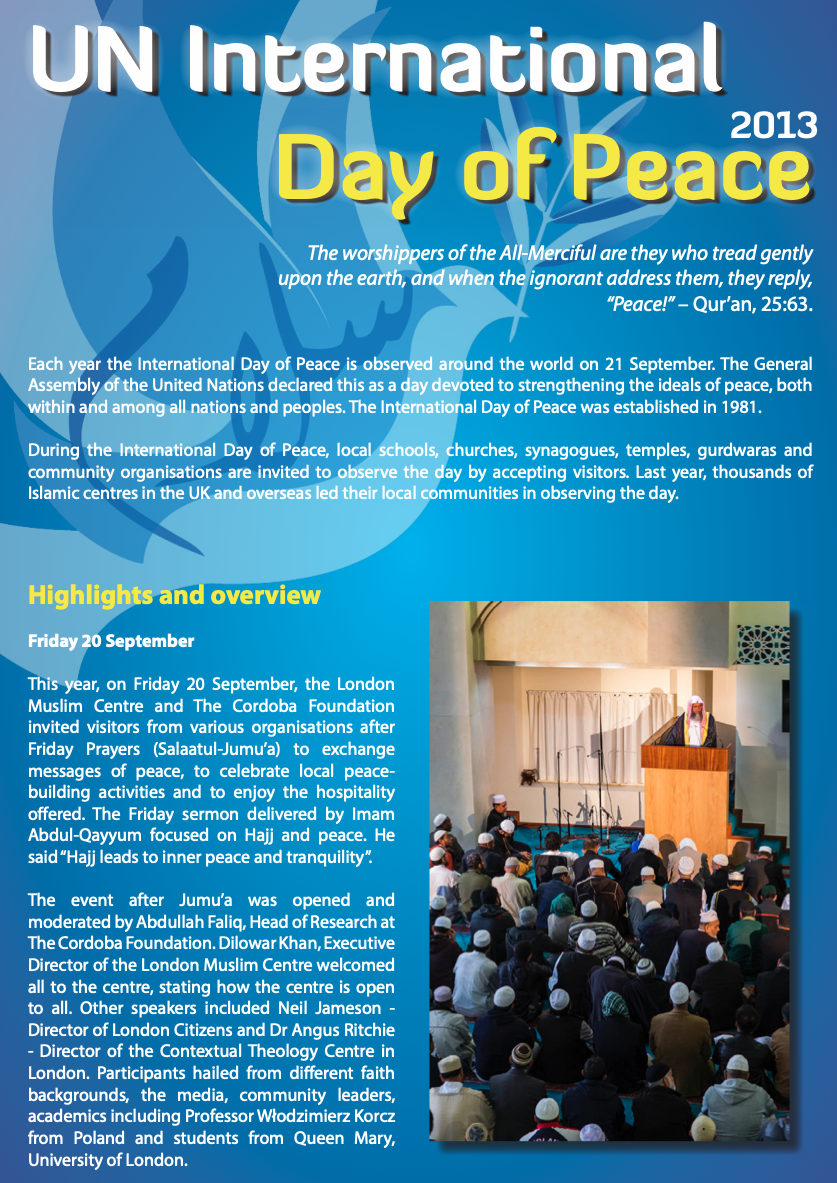
On the International Day of Peace, 21 September, The Cordoba Foundation (TCF) will be joining other organisations and faith institutions to express solidarity with all efforts intended to make this world more peaceful.
As the day falls on a Friday when Muslims gather for their weekly afternoon Friday Prayers, Salatul-Jumu’a, this year’s celebration will be particularly poignant as mosques and Islamic centres in the UK will open their doors to visitors wishing to join them during or after Friday prayers. People of different faiths and none will exchange messages of peace, celebrate local peace-building and share hospitality. They will be joined by others overseas, some as far as Sri Lanka and Thailand.
Abdullah Faliq, Head of Research at TCF, which has been working on this campaign from the outset, explained: “Unlike launching into war, establishing peace requires a lot of determination and continuous effort. We are delighted that people of all faith and none have come together to mark the International Day of Peace this year with so much vigor and passion.”
In such a turbulent period of global history, TCF Chief Executive, Anas Altikriti, stressed that “peace is not the absence of conflict and violence, but rather the establishment of justice through mutual respect, understanding and acceptance”.
Thus the International Peace Day is a reminder to all of us to find alternatives to what threatens peace and harmony and to provide a space for people to realise their own destinies.
TCF is particularly delighted to release a special edition of its Occasional Papers series, in commemoration of the International Day of Peace. Titled, Sustainable Peace for a Sustainable Future, it features an article by the Grand Mufti of Bosnia-Herzegovina, and messages of support from Dr Rowan Williams, Archbishop of Canterbury; Professor Ekmeleddin Ihsanoglu, Secretary General of the Organisation of the Islamic Corporation (OIC); Jeremy Gilley, Founder of Peace One Day; Catriona Robertson from London Peace Network. The Occasional Papers will be released at a ceremony hosted by Lord Bates to mark the official launch of International Peace Day at Westminister Hall, Houses of Parliament (UK) on Friday 21st September at 11am.
TCF commends London Peace Network (and its partners), for undertaking such an unprecedented initiative of linking UK Islamic centres with other institutions.
Commenting further on this Anas Altikriti, said “We are taught that we do not inherit the earth from our forefathers but we borrow it from our grandchildren. We need to all collectively work towards the promotion of peace and understanding between cultures and civilisations. This initiative is the right and first step and needs all our support”.
[Ends]
Notes to editors:
1. For a full list of participating mosques and Islamic centres, see
http://londonpeacenetwork.wordpress.com
2. Media / general enquiries about International Peace Day:
Catriona Robertson, London Peace Network, 07903 682 142, convener@lbfn.org
Julian Bond, Christian Muslim Forum, 07813 018 450, info@christianmuslimforum.org
Abdullah Faliq, The Cordoba Foundation, 0208 991 3372, abdullah@thecordobafoundation.com
Ali Abbas Razawi, Majlis-e-Ulama Europe, 07894 277 658, sayed.a.r@hotmail.co.uk
3. Link to introductory film
http://www.youtube.com/watch?v=yrF7vSOBSbM&feature=youtu.be
4. For anyother enquries, please contact Amjad Saleem, Head of Communications, The Cordoba Foundation, 020 8991 3370 / media @thecordobafoundation.com
Aug 23, 2012 | Views
The two most repeated words in the English Language are “Never Again”, heard in commemorations of the Holocaust to express the commitment that genocide will never again take place. Yet “Never Again” has also come to symbolise the absolute weakness in the will of the international community to act against genocide. This weakness was exposed in Bosnia and in Rwanda and now it seems that it is being exposed yet again, now in Myanmar with its ethnic Rohingya people, a Muslim minority living in the Arakan region.
As reports of mass killings, mass graves, rape, and torture come out of Myanmar with figures of at least 20,000 Rohingya killed since June 28, it seems that like Rwanda and Bosnia, a group of voiceless people are once again being systematically wiped out. This seems to be sanctioned by their government, under the eyes of the international community. The pictures in circulation (although it is hard to verify their authenticity sometimes) depict the horrific nature and scale of the existing tensions in Myanmar.
Many of the Rohingyas have been forced to flee to Bangladesh by boat with some reportedly travelling for days on end to escape the trauma of the current situation. However, they have been refused entry by the Bangladeshi government which has also suspended aid agencies from working in the camps which harbour Rohingya refugees.
Perhaps what is even more shocking is the complicity of the entire country of Myanmar, from the President down to the grass roots. The President has come on record to tell the UN to “establish refugee camps and allow for the deportation of ethnic Rohingya as the ‘only solution’”, whilst Buddhist monks have backed calls for the extermination of the race of Rohingyas. This statewide support for the killing of “Kalaras”, which is the pejorative slur that has become a popular and casual way of referring to Muslims of South Asian decent – or the Rohingyas – is once again reminiscent of Rwanda which witnessed an exhortation for mass killings over the public airwaves.
For more information, please click here
Aug 21, 2012 | Views
What a difference a year makes. This time last year, London and the rest of the United Kingdom were in a state of shock as riots (and subsequent looting) held the authorities hostage for over a week. Writing on this subject back then, I stressed that what was needed was a collective response from both the government and wider society in dealing with the complex background context that had fermented the riots. I talked about the need to engage with each other and to start the process of ‘linking’ to not only understand each other but to strengthen communities, add to social cohesion and contribute to personal and professional development through friendships made, as well as work undertaken across the partnerships. Linking, partnerships, and engagement all mean the same thing: a sense of cooperation that leads to better understanding that should be encouraged and supported. This is a powerful tool for the promotion of dialogue, tolerance, and harmonious living.
However, since then, despite assurances of addressing some of the real issues, it seems that not much has really been done. Some compensations have been paid out (though it appears not in amounts promised), damaged buildings have been rebuilt and looters have been jailed. But there has been very little done to address some of the underlying factors that precipitated the riots.
To read more, please click here
Aug 10, 2012 | External News
The open-ended Extra-ordinary Executive Committee of the OIC convened at the Permanent Representative level on 5th August 2012 at OIC Headquarters to discuss the critical situation of the Muslim ethnic Rohingya minority under the chairmanship of Mr.Bakhyt Batyrshayev, Permanent Representative of the Republic of Kazakhstan to OIC. After a round of discussions, the Committee;
Proceeding from the principles and objectives of the Charter of the Organization of Islamic Cooperation and pursuant to the resolutions on the question of Muslim Minorities and Communities;
Stressing the need to respect the universally accepted human rights and norms and principles of international humanitarian law;
Condemning the continued disregard of international law by Myanmar and its detrimental implications for regional and global peace, stability and security;
Appreciating the efforts of the OIC Group on Human Rights and Humanitarian Issues in Geneva to highlight the Rohingya issue in line with the Secretary General’s proposals;
Commending highly the efforts of the Secretary General to resolve the issue of the Rohingya minority in Myanmar by convening this extra-ordinary executive committee and his early and timely response to the situation in Arakan particularly by communicating to the UN Secretary General, UN High Commissioner for Human Rights, ASEAN Secretary General, EU High Representative, President of Myanmar and Chairperson of National League for Democracy, and expressing concern to governments in the region particularly with the People’s Republic of China during his recent visit;
Welcoming Catherine Ashton’s statement on July 22, 2012 stating the EU is closely monitoring acts of violence against the Muslim minority in Myanmar and will be dispatching experts from the European Community Humanitarian office (ECHO) to Myanmar to determine the urgent needs of the Muslims. The UN High Commissioner for Human Rights’, Navi Pillay, statement on July 27th, 2012 claiming that Muslim Communities in Arakan State were being targeted by Myanmar security forces and the announcement of sending a special rapporteur to Myanmar. The Visit by Vijay Nambiear, Special Adviser on Myanmar to UN Secretary General, Ban Ki-moon, to Arakan state in Myanmar after the violence erupted.
Having listened to the speech of the OIC Secretary General, the presentation of Dr.Wakar Uddin, Director General of Arakan Rohingya Union (ARU), and to the interventions of Head of Delegations,
1. Condemns in the strongest possible terms the brutal aggression and systematic gross violations of human rights committed by armed gangs and encouraged by the authorities and condemns in particular the involvement of security forces and their instigation in the clashes by the Myanmar authorities and Buddhist against innocent unarmed Muslim civilians;
2. Emphasizes that the atrocities committed against Rohingya minority in Myanmar including killing, razing houses, forced eviction, forced labor in harsh conditions, summary executions, rape, torture have approached the crime of genocide and represent a serious threat to international peace and security and regional stability, as clearly demonstrated by the recent violence. It is a serious crime against humanity, and a blatant breach of international law, which needs to receive proper reaction by the international community through bringing Myanmar authorities who are responsible for these heinous acts to justice;
3. Reiterates its firm and unwavering demand for an immediate halt of the unlawful acts of crimes against humanity perpetrated towards Rohingya in Myanmar and the opening of Myanmar borders to allow for unfettered humanitarian access;
4. Highlights the United Nations Declaration that the “Rohingya are a linguistic, religious, ethnic minority from western Burma”.
5. Calls upon the Myanmar authorities and Rakhine Buddhists to abstain from the use of force and violence and give precedence to peaceful resolutions through dialogue towards national unity.
6. Recommends;
a) Member States to support the United Arab Emirate’s call for a special session of the Human Rights Council and urgently request to file a collective complain to the UNHRC urgently requesting to dispatch a Commission of Inquiry. The council should also ask Myanmar to cooperate fully with the Commission and to take measures to ensure the accountability of all violations of human rights in order to prevent their repetition and continue to monitor the situation.
b) Request the OIC Secretary General and Member States to explore all possible means through engagements with the United Nations including tabling of a Rohingya Muslim specific resolution in the 3rd Committee of the UN General Assembly at the 66th Session of the UNGA.
c) Member States request the OIC Independent Permanent Human Rights Commission (IPHRC) to examine the situation of Rohingya Muslim minority in Myanmar as a priority issue on its agenda requiring immediate attention and action while presenting concrete recommendations to the Council of Foreign Ministers (CFM) towards addressing the issue in an effective manner.
d) Call on all Member States and non-Member States and local and international NGOs to provide Humanitarian assistance to Rohingya Refugees as well as to the internally displaced in Myanmar.
e) OIC Member States to use their diplomatic contacts at the highest level to help alleviate the sufferings of the Muslim population of Arakan.
f) Urges OIC Member States, international organizations, along with Islamic and international civil society organizations to move promptly and provide necessary and urgent humanitarian assistance to the Rohingya people and to assist them in surmounting this grave crisis, in line with the statement issued by the OIC Secretary General in which he appealed to OIC Member States and humanitarian international organizations to do so.
g) Decides to establish an OIC contact group in close coordination with Arakan Rohingya Union composed of all ASEAN Member States who are Member States of the OIC (Brunei, Indonesia, Malaysia) along with a representative of ASEAN Secretary General and OIC Secretary General. The rest of the membership will be decided by consultation between the OIC Secretary General and interested Member States. The group is mandated to consider ways, means, and mechanisms to ensure the halt of human rights violations against Muslim Rohingya in Myanmar and the return of their citizenship rights.
h) Recommend the Secretary General to appoint a special envoy for this important issue.
i) OIC Secretary General to submit his report to the 4th Extra-ordinary Summit on 14-15 August 2012 in Makkah Al-Mukaramah and the 39th CFM for necessary actions.
j) Send a High- level OIC Representative to Myanmar stand-alone and/or with the OIC Contact Group in Naypidaw.
k) Requests the UN Secretary General to intensify UN activities in order to immediately and unconditionally halt the violence against Rohingya Muslims in Myanmar and alleviate their suffering;
l) Requests the OIC Group in Geneva to follow up the request of the United Arab Emirates’ call for a special session of the Human Rights Council and ensure all OIC Member states to play a positive role in adopting all recommendations specifically a Commission of Inquiry;
m) Call upon world leaders to speak out against these crimes against humanity and urge the Myanmar Government to eliminate the discriminatory law and any other discriminatory practices against the Rohingya people.
n) OIC Member States to remain seized on this matter and requests the Secretary General to provide progress reports on the matter.

Aug 10, 2012 | News & Press
Call to Action: Rohingyas of Myanmar Need Support
From June 2012, deadly sectarian violence in western Myanmar’s Arakan State between the ethnic Arakan Buddhists and the Rohingya (and non-Rohingya Muslim) communities is part of a long running saga of tension, racism and oppression, which has seen thousands die and hundreds of thousands displaced over the last many decades.
President Thein Sein in July told the United Nations that refugee camps or deportation was the “solution” for the Rohingya.
WHAT CAN WE DO?
This unfolding humanitarian tragedy has an international dimension and requires determined support from all. By applying sustained pressure on the appropriate authorities, through our local
communities, we can bring about change to this apartheid.
This is a human tragedy, and one which affects us all, irrespective of our colour, creed, race or religion. Therefore, please be generous with your
time, wealth and support.
We can all help in raising awareness of the plight of the Rohingya people.
To find out more about what we can do, please click here
To get involved with the campaign, please visit the website of the RMCG
Aug 3, 2012 | News & Press
Faith-based organisations must take a lead in enabling youth to find meaning and purpose in their lives, recommends a report on the riots, which shook London and other cities in England a year ago.
Entitled ‘After the Riots: From Blame to Positive Action’, the report contains the conclusions of a national forum, jointly organised by Initiatives of Change UK, The Cordoba Foundation, Burning2Learn and the Civil Society Forum.
The forum, which was held on 1 February 2012, dealt with the moral and values dimensions of the problem.
The forum brought together some of the principal players, young and old, who were involved directly with the riots, either as perpetrators, victims or people who prevented the riots taking place in their communities.
At the forum, young people were given the chance to air their views and opinions in an open and safe environment and candidly expressed their frustrations about various issues; the relationships with authorities, such as the police, and the lack of job opportunities.
Stressing that ‘this is not the time to despair’, the report states: ‘Throughout Britain, there are seeds of hope. These are sown by community groups and organisations. Out of the bankruptcy of failed regeneration efforts, a new set of organisations are emerging in inner cities. Change and development is taking place at the local levels.’
One of the key segments in the forum, according to the report, was the sharing of initiatives of change, led by individuals and communities. The participants heard case studies of how, against all odds, individuals and communities have created small projects – some even big ones – to tackle issues such as, poverty, gun culture, drugs and unemployment.
The report concludes: ‘All efforts to tackle the root causes of unrest need to take into account these experiences.
‘Solutions to problems abound. The challenge for all of us, particularly decision makers, would be to ensure that such initiatives are sustainable and facilitate similar positive action throughout the country.’ (Don De Silva, Initiatives of Change)
arches2
To read the report, please click here
To find out more about the event, please click here