Apr 11, 2013 | News & Press
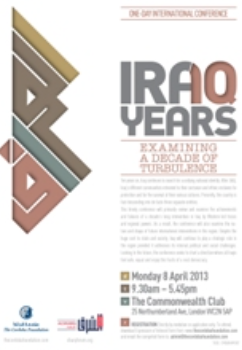
Iraq is edging closer to civil war and break up into separate states, with almost none of its pre-invasion promises coming to fruition, experts warned at a ground-breaking conference held on the future of the country in Central London.
 Ten years after the fall of Baghdad, policy-makers, politicians, academics, military experts, ex-senior military officials and voices from across the Middle East converged at The Commonwealth Club in London (8th April) to debate Iraq’s future and its bloody past decade.

Watched by international media, Dr Anas Altikriti, CEO of The Cordoba Foundation, reflected on his time as a hostage negotiator, attempting to secure the release of fellow conference speaker Professor Norman Kember and other hostages in 2005/6. He said: ‘The people of Iraq have been through quite a rollercoaster. But we didn’t just come and discover these problems in 2003: we have seen divisions for centuries.’
Co-organiser, Wadar Khanfar of Al Sharq Forum and former Al Jazeera director general, recalled seeing the signs of a ‘new’ Iraq as part of Al Jazeera’s bureau in the country: ‘Ten years ago I was covering the war in Iraq. I remember as I entered Baghdad that all the state buildings were on fire. It was not the image of a free Baghdad that people wanted to see.’
‘Ten years later I don’t see Iraq and Baghdad as having moved forward.’ The failures, he said, could be traced back 100 years to the end of the First World War, with ‘deep suspicion’ among many observers about the latest conflict. He warned that three de-facto states could soon appear where now one (Iraq) exists.
‘Iraq is not at a crossroads,’ suggested Middle East Monitor director Dr Daud Abdullah, ‘it has passed it. The north is a de facto state, with Irbil not even talking to Baghdad about oil contracts. The world’s third-largest oil producer has 36% of its citizens living in poverty.’ He suggested that the presence of death squads and private militias was similar to the El Salvador “dirty war” in the 1980s, with current premier Al-Maliki concentrating power in his hands alone.
 The attitude of the Americans and their allies was ‘naive, lacking depth and profundity’ prior to the 2003 invasion, said Professor Rosemary Hollis, former research director of Chatham House. ‘There was too much emphasis on elections, as though that would create democracy.’
Clare Short, former Minister for International Development, counselled  against attempting to re-draw colonial boundaries, arguing it was time to ‘unite the region’ rather than recreate it. She referred to the former neo-conservative movement, the Project for a New American Century, and its ‘terrifying documents’ planning the (mythical) future of Iraq.
Various academic speakers, including Professor Phil Marfleet of University of East London, said that there was a dearth of academic research into Iraq post-2003, particularly the humanitarian costs, labeling this ‘the politics of denial’.
Dr Nabil Ramadhani of the Human Relief Foundation revealed shocking statistics showing the decline in living standards, increase in poverty, and the threats women face – attacks and sexual assaults – even travelling in their own neighbourhoods. ‘Iraqi women have paid a high price for the war and occupation of their country.’
Drawing the event to a close, Dr Altikriti said that the Iraqi people and the rest of the world had been offered a false choice between Saddam and what the Americans said they would bring afterwards. ‘There were other ways, other choices,’ he said, arguing that international law had been degraded and flouted, creating a world in which we were all now less safe and damaging democracy even here in the UK.
[End]
Notes:
1) Please click the links to get the conference briefing, the speaker profiles and the schedule for the conference
2) Please see below for a selection of photos (courtesy of Richard Chambury; William Barylo and Noridine Bendou)


Apr 7, 2013 | Views
Ten years ago, before the world’s mesmerised gaze, an iconic statue of Iraq’s former dictator was pulled down amid a throng of jubilant Iraqis. None of those present or bearing witness could have envisaged the extent, scope and depth of the pain that would ensue over the next decade.
Among those who danced in jubilation and took part in slapping the head of the statue with his slippers was a local taxi driver, Abu Ahmed Al-Mishadani. An Arab Sunni and 38-years-old at the time, he too saw this as the end of the darkest of eras and the start of a new dawn. Married to a Shi’i woman and with five children, his aspirations and hopes for the new era of freedom and dignity were unlimited. He had seen the inside of a Ba’thist prison cell and the fiery end of an electric rod too many times to allow himself a moment’s grief over the collapsing tyrant.
Yet since then he has been arrested three times, imprisoned for two-and-a-half years, tortured, had seven of his fingernails extracted, his skull fractured, both his legs and his left arm broken and his ‘honour’ violated more times than he can remember. This last description usually implies rape and sexual abuse, of which he is too ashamed to speak. Each time he was picked up by a different group: militia this, army that. Each time he pleaded with his captors to tell him the reason for his arrest. Each time he got no answer. The only answer that makes any sense to him is the one he gives to whoever cares to ask: I am a Sunni; that’s why. His wife Zahra’ nods in agreement.
Of course the experience of one individual cannot be used to paint a picture for an entire nation’s life across a whole decade. However, this story is repeated time and again with slight variations in the details, the injuries, the assailants and lasting wounds. There are Shi’as who tell similar horror stories, and Kurds and Turkmens and Christians and Sabians. Indeed, there are far too many stories to consider the experience of Abu Ahmed an isolated case of individual corruption and mishandling.
Ten years on, Iraq lingers at the bottom of the global transparency index, beaten only by five other more corrupt countries. Indeed, according to the very same American politicians who hailed the ‘New Iraq’, corruption is at an unimaginable and on an endemic scale. The Mercer Index points to Baghdad as the worst city in the entire world to live in, bar none.
More than 20 million Iraqis, or 76% of the entire population, do not have regular and constant electricity and/or clean running water. There is virtually no education and health system to speak of, the country’s infrastructure resembles something out of ancient times, hundreds of thousands of civilians have been killed, and more than five million driven into exile either within or outside Iraq. Furthermore, sectarianism has firmly taken grip of a country that, despite its former tyrannical regimes, never managed to dictate the social or political fabric of Iraqi society as attested by Abu Ahmed and hundreds of thousands of other Iraqi families where the make-up is a mixture of all of Iraq’s intrinsic and organic strands.
In the past few weeks, as we commemorated the 10th anniversary of the largest anti-war demonstration in British history – which I chaired – the 10th anniversary of the war and now the 10th anniversary of the occupation of Iraq, the question asked by most media commentators and presenters is: is Iraq better or worse now than under Saddam Hussein?
The question is unfair and any answer tells us nothing new. After all, who proposed that the Iraqis had only two choices: either the dark and tyrannical days of the Ba’thist regime, or the present misery, pain and inhumanity? Why can’t Iraqis condemn both and yearn for something else, far better, far fairer and far more humane? Why should Iraqis answer such an unreasonable question in order to exonerate either a pro- or anti-war position, when it’s clearly a subjective standpoint either way?
A decade on from one of the most controversial and divisive decisions in modern times, few can claim to have fared well. Not the occupying forces which, despite gaining an military victory, lost on so many other fronts. If reports and briefings by security advisors are anything to go by, heightened terrorism alerts in the UK and the US have much to do with Iraq and its ramifications.
The country has never been so close to an all-out civil war, nor has it been ever closer to breaking up into three separate entities, than it has now. With neighbouring Syria in a state of meltdown and Iran aiming to widen its net influence in the region, the impact of the Iraq failure may be felt far and wide – and not only by Iraqis destined to suffer another generation of abject misery.
Tony Blair, under whose premiership Britain went to war and subsequently occupied Iraq, may cite the disposal of Saddam Hussein and the guise of democracy in Iraq all he wants to prove that he made the right decision. The enduring legacy of that decision, however, will be that millions of Iraqis from across the country’s sectarian, religious and ethnic divides, have come to believe that they are now suffering far greater than they did under Saddam. And boy did they suffer. But for those who did – Abu Ahmed Al-Mishadani, his wife Zahra and thousands more like them, who celebrated the departure of the former dictator 10 years ago – are forced today to grieve over the loss of their collective humanity, dignity and dream.
The Cordoba Foundation along with The Sharq Forum, is organising an international conference on the 10th anniversary of the fall of Baghdad on Monday 8th April at the Commonwealth Club in central London.
Follow the conference on twitter (and join in the conversation) #Iraq10yrs

Apr 5, 2013 | News & Press
“non violence is a set of attitudes, actions, or behaviours intended to persuade the other side to change its opinions, perceptions and actions” was the message that was presented at a talk held on the 21st of January 2013 at St Ethelburgas Centre for Peace and Reconciliation and co sponsored by The Cordoba Foundation to commemorate Martin Luther King Day.The speaker was Dr Ayse Kadayifci from Georgetown University, an expert on Islamic peace building and non violence.
According to Dr Kadyifci, successful non violence requires great strength of character, perseverance and discipline. It is a means of awakening a sense of injustice and moral shame in the supporters of a power structure, showing them that they have more to gain by ending injustice and oppression than by maintaining them. It is also about exposing the unjust means of a power structure, the isolation of actions, changing the narrative that can be used for justification.
Strategic use of non violence thus is means to resist the power structure though long term social and economic policies including education and microfinance. You let the community acquire the necessary knowledge and skills to advance in society and challenge the status quo of the power structure and provoke it in order to expose its unjust means and illegitimacy by seeking to prevent the advancement of the community.
Noone communicated this moral priority more than Martin Luther King, who despite losing his supporter base would shift attention from the civil rights movement to economic injustice and the Vietnam war in 1965, which unfortunately have been erased from the cultural narrative of his life and legacy.
 In his 1963 letter from Birmingham jail in particular, King drew inspiration from the gospel and biblical teachings in order to justify his fight against injustice. Injustice anywhere is a threat to justice everywhere. He mentions just and unjust law and offers insight into how not only the church but other faith leaders and communities should act in the face of injustice. In King’s words, it is about being a thermostat that transforms the morals of society.
His phrase, ‘if the church of today doesn’t recapture the sacrificial spirit of the past, it will lose its authenticity. It will forfeit the loyalty of millions and will be dismissed as an irrelevant social club with no meaning’, is the challenge that he sets for us today, people of faith and no faith to see where we stand during times of challenge and controversy, rising above the narrow confines of our individualistic concerns to the broader concerns of all humanity.


Apr 5, 2013 | News & Press
‘Faith is a restraint against all violence, let no believer commit violence’ (Hadith, Recorded sayings of the Prophet Peace Be Upon Him)
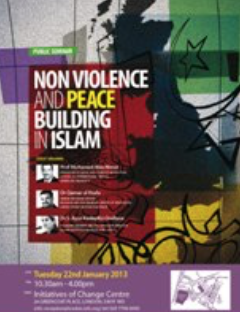
This saying formed the backdrop for a seminar on ‘Peace building and Non Violence from Islamic Principles’ organised by Initiatives of Change, The Cordoba Foundation and Islamic Relief Worldwide on the 22nd of January 2013 where scholars Dr Ayse Kadayifci-Orellana (Georgetown University), Professor Mohammed Abu Nimer (Salam Institute and American University) and Imam Ajmal Masroor gave their unique perspectives on the subject.
 Speaking first, Ayse painted a theoretical picture of the concept of peacebuilding from an Islamic Perspective. Whilst Muslims agree that Islam is a religion of peace and the application of Islamic precepts will bring justice, harmony and order, consequently peace to the world, academic scholars often paint Islam as a religion of peace and tolerance, which permits the use of violence only under certain well-defined conditions focussing instead on the specific conditions and circumstances under which Islam allowed the use of war to settle conflicts.
Prof Abu-Nimer contends that, although these scholars have attempted to present a more balanced perspective of Islamic traditions, they have “approached this topic from a framework of security, power politics, strategic studies or classical Islamic studies, not peace and conflict resolution” (Abu-Nimer 2003, 26) and therefore failed to pay sufficient attention to inherent traditions of non violence and peaceful resolution of conflicts which have been an integral aspect of Islamic tradition since the time of the Prophet Mohammed ( PBUH). In particular, the practice by Prophet Mohammed’s (PBUH) attitude towards peace and his diplomacy, can be summarized as the “reconciliation of hearts” which meant “coming to terms with adversaries and enemies and the contractual guaranteeing of agreements”, and that he preferred peaceful regulation of conflicts and peaceful resolution of enmity. Based on the Qur’anic verse “We did raise among every people a Messenger (with a teaching): Worship God and Shun the Evil one” (Q16:36), scholars such as Jawdat Sa’id of Syria argue that “the Prophets come with the message to avoid wicked tyranny and they disclosed that the tyrant could not continue to exist without our obedience to him.”
 Derived from the Quran, the Hadith and the Sunna, an Islamic conception of peace begins with its attribution as a divine name since the Arabic word for peace, as-Salam, is one of the ninety-nine names of God (Qur’an – Q 59:23). There are many references to peace (salam, silm, sulh, etc.) in the Qur’an that suggest that peace, together with justice (adl) is a central message of Islam (Q 3:83; 4:58; 5:8; 10:25; 16:90; 41:11; 42:15; 57:25) These references make it clear that peace in Islam is not limited to a negative understanding of peace that is often defined as the absence of war, oppression or tyranny but it actually refers to a process in which human beings strive to establish foundations for interacting with God’s creation – human and non-human alike—in harmony and to institute just social, economic and political structures where they can fulfil their potential . Such an understanding of peace thus requires a condition of both internal and external order that encompasses both individual and social spheres as “the individual must be endowed with the necessary qualities to make peace an enduring reality, not only in the public sphere but also in the private domain”.
Dr Kadayifci then spoke about some of the values that drive Islamic principles of peace building and non violence including the quest for justice (political / social / economic) or Adl; the concept of social empowerment or Ihsan ( benevolence); the concepts of : compassion or Rahmah; wisdom or Hikmah; service or Amal; faith or Yakeen; love or Muhabbah and patience or Sabr.
 Ajmal Masroor presented his own experiences growing up in the UK of tackling prejudice and extremism on the road to peace building. He spoke about the need first to reconcile within ones heart as the first step towards peace building and non violence and finding peace with enemies.
Resolving conflicts in different Muslim contexts requires an understanding  of the dynamic relationship between the Islamic tradition that unites Muslims and the unique geographical, cultural, historical and political contexts of each Muslim community that impacts specific tools for resolving conflicts. Islamic culture is not an ‘object’ that can be reified into one objective or dimension;” nor is it distributed uniformly among all Muslims. Culture is not a static entity that can be identified as a constant, but it is always in the making, constantly evolving and changing with the experiences and context of society. Furthermore, there is more than one Islamic culture depending on geography and demography as well as various subcultures, within each community. Therefore, conflict resolution practices in different Islamic countries such as Egypt, Indonesia, Afghanistan, and Palestine, amongst others, have various differences due to their unique contexts. Such an understanding of culture allows us to recognize that each Muslim community will have many internal paradoxes, subcultures, and identities. This perspective also recognizes that each Muslim responds to the realities and challenges of life in their own unique way influenced by the many identities and subcultures s/he is a part of. These contextual factors and cultural differences have also led to different understanding of Islamic teachings and practices. In fact, as long as they do not contradict Islamic teachings, local customs (urf) are often considered a source of Islamic law.
In this regard, Professor Abu Nimer addressed some key issues surrounding the context of peace building within Islam. Looking at peace building within an Islamic context has to deal with the concept of justice and dignity. There is heavy emphasis on public image and the role of third parties cannot be underestimated whilst a lot is dependent on relationship building. Professor Abu Nimer also pointed out that a lot of the communities where peacebuilding is needed are burdened by colonial history adding additional challenges to narratives of coexistence and non violent resolutions of conflict.
The seminar touched very briefly on various community conflict resolution mechanisms that have been developed and effective applied to resolve conflicts in the Muslim world such as wasata (mediation), sulha (reconciliation) and hewar (dialogue).
Please click here to view a video of the proceedings (video courtesy of IoFC)
A selection of photos are presented below courtesy of Jonty Herman and Amaani Niyaz


Apr 4, 2013 | News & Press
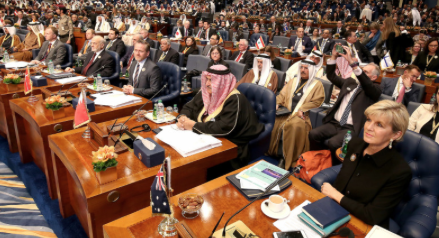
The following speakers have now been confirmed to speak at the forthcoming conference ‘Iraq 10 Years – Examining a Decade of Turbulence’ on the 8th of April 2013.
- Wadah Khanfar – Director, The Sharq Forum (former DG of Al-Jazeera)
- Clare Short – Former Minister for International Development
- Jonathan Fryer – British writer, broadcaster and academic
- Dr Basil Hussein – Expert on Iraqi politics
- Professor Rosemary Hollis – City University; formerly with Chatham House
- Professor Norman Kember – Christian pacifist activist, held captive in Iraq in 2005
- Ahmed al-Hemyari – Head of Public Relations, Al-Shaheed Al-Sadr Office, London
- Professor Phil Marfleet – Director, Refugee Research Centre, University of East London
Places still available. Please click here to register
For further information about the conference, please click here

Mar 28, 2013 | News & Press
The 9th of April 2013 will mark 10 years after the fall of Baghdad and in what was to be a symbolic justification for the intervention by Allied forces, the statue of Saddam Hussein was toppled in Baghdad amidst televised scenes of ‘jubilation’.
Ten years on, Iraq continues to search for a unifying national identity. After 2003, Iraq’s different communities retreated to their sectarian and ethnic enclaves for protection and for the survival of their various cultures. Presently, the country is fast descending into de facto three separate entities.
A timely conference to be held on 8th April 2013 at The Commonwealth Club, organised by The Cordoba Foundation and The Sharq Forum will primarily review and examine the achievements and failures of a decade’s long intervention in Iraq by Western-led forces and regional powers. The conference will also examine the nature and shape of future international interventions in the region. Despite the huge cost to state and society, Iraq will continue to play a strategic role in the region provided it addresses its internal political and social challenges.
Speaking at the conference will be a number of dignitaries including the Rt Hon Ms Clare Short, former minister for International Development; Waddah Khanfar, former Director-General of Al Jazeera & Director, the Sharq Forum; Professor Norman Kember, Emeritus Professor of Biophysics at Barts and The London School of Medicine and Dentistry and a Christian pacifist activist, who was held hostage for four months after travelling to Iraq in 2005; Dr Anas Altikriti, CEO of The Cordoba Foundation, and, part of the team that successfully negotiated the release of Western hostages including Professor Kember in 2005; Mohamed al-Daini, former member of the Iraqi Parliament; and Professor Rosemary Hollis from City University, London, and former Director of Research at Chatham house.
The organisers hope that through this gathering of international stakeholders, it will help chart a course to a proper democracy and human rights, where all Iraqis feel safe, equal and enjoy the fruits of a real change.
[End]
For more information about the event, please click here
Mar 27, 2013 | External News
In Myanmar’s capital Yangon, on March 20-21, a business investment summit presented Myanmar as a stable, growing democracy eager to establish agriculture, infrastructure, financial and manufacturing partnerships with leading international companies.
The messages were clear _ Myanmar’s transition to democracy is irreversible, wide-ranging reforms are underway and the country is now ripe for investment and trade.
Investors flocked, excited about new business prospects in a country that had been economically and politically isolated for decades.
In stark contradiction, and with devastating consequences, extreme brutal violence was unleashed against Muslim residents of the township of Meiktila near Mandalay.
The aftermath of the attacks, which took place on the same day as the summit, left Meiktila looking like a war zone. Scores of buildings, including many shops and mosques, were razed to the ground. Reports from local media and human rights organisations claim hundreds may have been killed in the attacks.
Eyewitnesses have told horrific stories of people being stoned, beaten and burned to death. Among the most chilling reports to have emerged is one of 28 students, including many orphans, and four teachers at an Islamic school being beaten to death by a large Buddhist mob.
Over the weekend, fear and violence spread, with attacks reported in other parts of the country including in Nay Pyi Taw, Bago, Yamethin and Yangon. On Sunday night, three trucks of armed vigilantes mounted attempted attacks on Muslim shopkeepers and mosques in downtown Yangon, mere minutes away from the popular Aung San Market and five-star hotels close by.
The most alarming feature about the recent violence is that it bears the mark not of “communal clashes”, but of carefully calculated and systematically planned attacks against a minority. Indeed, at the height of the attacks, many shocked Buddhist residents of Meiktila even risked their own lives to protect Muslims in their homes or drive them out of the city.
Local Muslim organisations have been warning for many months about mounting anti-Muslim campaigns by radical Buddhist groups, including the recently established 969 Movement, who are believed to have instigated the Meiktila attacks. Anti-Muslim incidents have increased steadily over the past few months, including the demolition of an Islamic school on the outskirts of Yangon by a mob of 300 Buddhists on Feb 17.
To read this article in more detail, please click here
Mar 27, 2013 | Views
Turkey began 2008 in the shadow of a very heated debate over whether female students could cover their hair with a headscarf — a practice banned in Turkey since 1989. In February 2008, the Justice and Development Party (AKP), a “conservative” party led by devout Muslims, with the support of two other parties, passed an amendment that inserted two clauses into the constitution. One of them stated that all citizens, regardless of their religion, race, or ethnicity, would “benefit from public services equally.” The other amendment provided a guarantee: “No citizen can be barred from the right to higher education.”
To the secularist establishment, however, these declarations constituted an unacceptable heresy. The Constitutional Court stepped in nullifying the amendment and also levying a hefty fine on the AKP for violating the country’s self-styled secularism.
In the middle of this peculiar political controversy — during which “freedom” and “secularism” had become opposing and polarising slogans — an interesting voice emerged from female students wearing headscarves, whose right to education was being discussed. On a website titled “We Are Not Free Yet,” three hundred students put their signatures in support of a statement which mentioned an “authoritarian mentality” and tied this struggle to that of suppressed groups like the Kurds and Alevis.This genuinely liberal and Islamic message immediately became popular.
How all this came about is a story worth examining in the lessons that can be learnt for similar situations in the current Middle East.
History Revisited
The story above serves to highlight that Turkey is still the best example of a functioning democracy in the Middle East. Its Islamic movements and parties have almost never followed a radical agenda, and have even come to appreciate the blessings of modern liberal democracy. Therefore, the Turkish model has been cited as a source of inspiration for countries emerging out of the events of the Arab Spring.
There are two good reasons to doubt that the Arab world only needs its own Atatürks, however. The founder of the Turkish Republic, Mustafa Kemal Atatürk, had introduced radical secularist reforms in 1924 and 1938. Firstly, most of the regimes overthrown or challenged by the Arab Spring are the very secular dictatorships which used Atatürk as a model. Secondly, the Turkish story is much more complex than the ‘creation-ex-nihilo-by-Atatürk’ narrative
To read the executive summary, please click here
To read the longer version of this article in Arches Quarterly, please click here

Mar 25, 2013 | News & Press
The Cordoba Foundation (TCF) helped organise a two-day event in Brussels, Belgium, from 19-20 March, consisting of discussion and debates concerning fair treatment for all in Europe.
The main organiser, European Network on Religion and Belief (ENORB), is being consulted by the European Commission (DG Justice) on the current 10 year review of implementation of the Directives on Equalities and Fundamental Rights – which cover Religion and Belief.
Legal experts from member states and academic institutions as well as from R&B (Religion and Belief) organisations and networks at grassroots level took part in the two-day event. Conclusions and recommendations from the event will be submitted to EU officials.
Abdullah Faliq (Head of Research) and Noridine Bendou represented TCF in Brussels. Day one kicked off with a roundtable where chief guest, László Surján, Vice-President of the European Parliament, spoke about the need for communities to understand each other better for better community cohesion. The second day consisted of discussions, presentations, workshops, networking as well as site-seeing.
Please click here for a selection of pictures from the two-day event
[End]
Notes to editors:
1. Picture credits: Noridine Bendou, The Cordoba Foundation
2. Abdullah Faliq (The Cordoba Foundation) is a founding member of ENORB.
3. To find out more about the work of ENORB, visit www.enorb.eu